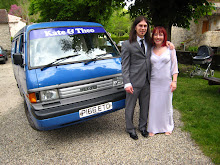
Conversation No 1: Kate and Rosie in the car
R: Hay barcos!
K: Donde? No hay agua aqui.
R: Si. Hay lago.
Conversation No 2: Theo and Roise at home
T: Que hiciste hoy?
R: Fuiste al parque, con mama.
T: Tienes que decir "fui al parque."
R: Fui al parque.
T: Bien. Jugabas sobre los columpios?
R: Y el tobogan!
Conversation No 3: Theo and Rosie in the park.
T: Quieres bajar el tobogan?
R: No, I want to sit on the swing-swing.
T: Quieres jugar sobre el columpio, de acuerdo. Y pues, quererias ir al lago para ver los patos?
R: Go and see the ducks! OK!
It's interesting that Rosie seems to have a worked out that, when in public, it is better to speak English even when spoken to in Spanish, as it increases the likelihood that she will be understood.
Showing posts with label English. Show all posts
Showing posts with label English. Show all posts
Sunday, 18 March 2012

Saturday, 26 November 2011
look who's talking NOW - by Theo
"All gone! Finished! NOW."
"Mama viene. NOW."
"Mas leche. NOW."
"Carry cuddle! NOW."
"Daddy up! NOW."
"Mas pan! NOW."

Rosie is rather imperative. It's unsurprising as regardless of the language most of the sentences we model for her are imperatives - "come here", "pon lo aqui", "hold my hand". So naturally as she begins to string sentences together from individual words, they are often orders, made with a sense of impatience and awareness that others may not have the same priorities that she clearly gets from her father.
She does descriptions as well, often related to clothing ("slippers off", "lleva gafas", "Rosie tired/cansada") and even has a few anecdotes that, with prompting from Kate, she can recount. One goes like this:
Kate: Rudy (a fellow toddler) tried to cuddle you.
Rosie: Mummy say "No kick!"
It's all astoundingly endearing (she had the museum attendant enraptured by her ability to say "cardie on" at the M Shed) and totally fascinating the way Rosie is acquiring and structuring language. Naturally her English is far more developed than her Spanish; though I suspect this is in part due to the fact she is trying to use verb phrases which is far easier in English ("he/she" form aside, the present tense and imperative are the same) than in Spanish, with its multiple endings and irregularities. For example she has been experimenting with the verb "ser" (to be): sometimes she gets it right by saying (to Kate) "es Papa!" ("it's Dad!"). But when she tells me "soy Papa", that's the wrong form - it's what I would say to her: Rosie needs to say "eres Papa". OK, the English version of this (am/are/is) wouldn't be much easier, but most English verbs don't change so dramatically.
"Mama viene. NOW."
"Mas leche. NOW."
"Carry cuddle! NOW."
"Daddy up! NOW."
"Mas pan! NOW."

Rosie is rather imperative. It's unsurprising as regardless of the language most of the sentences we model for her are imperatives - "come here", "pon lo aqui", "hold my hand". So naturally as she begins to string sentences together from individual words, they are often orders, made with a sense of impatience and awareness that others may not have the same priorities that she clearly gets from her father.
She does descriptions as well, often related to clothing ("slippers off", "lleva gafas", "Rosie tired/cansada") and even has a few anecdotes that, with prompting from Kate, she can recount. One goes like this:
Kate: Rudy (a fellow toddler) tried to cuddle you.
Rosie: Mummy say "No kick!"
It's all astoundingly endearing (she had the museum attendant enraptured by her ability to say "cardie on" at the M Shed) and totally fascinating the way Rosie is acquiring and structuring language. Naturally her English is far more developed than her Spanish; though I suspect this is in part due to the fact she is trying to use verb phrases which is far easier in English ("he/she" form aside, the present tense and imperative are the same) than in Spanish, with its multiple endings and irregularities. For example she has been experimenting with the verb "ser" (to be): sometimes she gets it right by saying (to Kate) "es Papa!" ("it's Dad!"). But when she tells me "soy Papa", that's the wrong form - it's what I would say to her: Rosie needs to say "eres Papa". OK, the English version of this (am/are/is) wouldn't be much easier, but most English verbs don't change so dramatically.
Saturday, 8 October 2011
NO! - by Theo
"No! No! NOOOOOO!"
Yes, Rosie has finally learnt the word "No!" She could of course express a negative opinion beforehand, but up until Friday this was usually done by shaking her head and arms and saying "da da da", which was, frankly, endearingly cute.
There is nothing cute about "No". In fact it is a hideous word. Sadly, of course, it's a very important one, in both English and Spanish. In fact it's probably more important in Spanish, as it's just put in front of the verb for a negative (whereas English puts "not" after) and is used as a general, often affirmative, question (E.g. "Te gusta el parque, no?" - you like the park, don't you?) So, we definitely brought this one on our own heads.
We are now both thinking of as many ways as possible to get "yes" into our sentences.
Yes, Rosie has finally learnt the word "No!" She could of course express a negative opinion beforehand, but up until Friday this was usually done by shaking her head and arms and saying "da da da", which was, frankly, endearingly cute.
There is nothing cute about "No". In fact it is a hideous word. Sadly, of course, it's a very important one, in both English and Spanish. In fact it's probably more important in Spanish, as it's just put in front of the verb for a negative (whereas English puts "not" after) and is used as a general, often affirmative, question (E.g. "Te gusta el parque, no?" - you like the park, don't you?) So, we definitely brought this one on our own heads.
We are now both thinking of as many ways as possible to get "yes" into our sentences.
Thursday, 4 August 2011
Rosie's talk - by Theo (chanelling Pat Hutchins)
Rosie the toddler went for a walk.
She walked through the "parque". Around the "agua". Over the "ball". Past the "doggle-oggle". Through the "door". Under the "bees" and got back in time to shout "dame!"
Rosie's speech is coming along rapidly, in both English and Spanish, from maybe only 10 words at the beginning of July to more than 50 now. She still expresses herself in single words, which are not always used correctly, as can be seen in this video from the morning we left Madrid.
"Dame" ("give me" in Spanish) gets used as a general expression of desire (e.g. "open", "take", "lift") rather than its more specific meaning. Meanwhile, pretty much anything with floppy ears and a tail is a "doggle-oggle" or a "oof-oof" (except for cats which are "miaow-miaows"). It's interesting which language she chooses - for example she says "agua" rather than "water" and "mas" rather than "more" but "please" rather than "por fa'" and "glasses" rather than "gafas". Some words could go either way - "yo-go" could just as easily be "yoghurt" as "yogur". Other words only get used in certain situations - for example, when pretending to answer the phone Rosie will say "si, si, si" but otherwise never comes out with the Spanish for "yes". There doesn't seem to be a pattern however, and so far she hasn't learned many equivalent words in both languages (except Mama/Mummy; Papa/Daddy and usefully, pi-pi/wee-wee and poo-poo/ka-ka). It's funny what words she picks up though - she says "cool" a lot, something she obviously gets from Kate and I, while earlier this evening she clearly articulated something that she definitely hadn't heard us say (ahem): "f*ck it!"
She walked through the "parque". Around the "agua". Over the "ball". Past the "doggle-oggle". Through the "door". Under the "bees" and got back in time to shout "dame!"
Rosie's speech is coming along rapidly, in both English and Spanish, from maybe only 10 words at the beginning of July to more than 50 now. She still expresses herself in single words, which are not always used correctly, as can be seen in this video from the morning we left Madrid.
"Dame" ("give me" in Spanish) gets used as a general expression of desire (e.g. "open", "take", "lift") rather than its more specific meaning. Meanwhile, pretty much anything with floppy ears and a tail is a "doggle-oggle" or a "oof-oof" (except for cats which are "miaow-miaows"). It's interesting which language she chooses - for example she says "agua" rather than "water" and "mas" rather than "more" but "please" rather than "por fa'" and "glasses" rather than "gafas". Some words could go either way - "yo-go" could just as easily be "yoghurt" as "yogur". Other words only get used in certain situations - for example, when pretending to answer the phone Rosie will say "si, si, si" but otherwise never comes out with the Spanish for "yes". There doesn't seem to be a pattern however, and so far she hasn't learned many equivalent words in both languages (except Mama/Mummy; Papa/Daddy and usefully, pi-pi/wee-wee and poo-poo/ka-ka). It's funny what words she picks up though - she says "cool" a lot, something she obviously gets from Kate and I, while earlier this evening she clearly articulated something that she definitely hadn't heard us say (ahem): "f*ck it!"
Friday, 31 December 2010
the perils of not having a Spanish keyboard - by Theo
Unlike French computer keyboards, Spanish ones are basically the same as English ones, which is generally helpful. However, when writing in Spanish, our English Mac Book is deficient in two important ways.
Spanish has two special characters. The first, the tilde, is an accent. While it doesn't change the sound of the vowel it marks which syllable should be stressed in words that don't follow the usual rules of pronunciation. As a non-native speaker I find this extremely helpful; pronunciation (even in English) has never been my strong suit. So, if it's just to do with how you speak Spanish, should it matter whether you include the tilde in written Spanish? Often it doesn't, but sometimes the tilde is the only indication of a change of tense. For example, hable means "he speaks" while hablé means "I spoke", hablará means "he will speak" while hablara means "he spoke (subjunctive)". So, out of context, the lack of a tilde can change the meaning. (Compare this to the English verb "read", which looks the same in both present and past forms, but is pronounced differently in each case.)
However it's the second Spanish special character that really causes problems. It's the 'ñ', pronounced n-ye, and often found with its own separate listing in Spanish dictionaries. As such using an 'n' instead of an 'ñ', a completely different letter, changes the meaning of the word entirely. This is particularly a problem around New Year when wishing Spanish friends a Happy New Year electronically; año means "year" while ano means "anus". Much copying and pasting individual 'ñ's from the El Pais website is therefore required.
So, Happy Anus Everyone!!
Lots of love and thanks for reading - we wish you love, peace and happiness for 2011!
Theo, Kate & Rosie x
Spanish has two special characters. The first, the tilde, is an accent. While it doesn't change the sound of the vowel it marks which syllable should be stressed in words that don't follow the usual rules of pronunciation. As a non-native speaker I find this extremely helpful; pronunciation (even in English) has never been my strong suit. So, if it's just to do with how you speak Spanish, should it matter whether you include the tilde in written Spanish? Often it doesn't, but sometimes the tilde is the only indication of a change of tense. For example, hable means "he speaks" while hablé means "I spoke", hablará means "he will speak" while hablara means "he spoke (subjunctive)". So, out of context, the lack of a tilde can change the meaning. (Compare this to the English verb "read", which looks the same in both present and past forms, but is pronounced differently in each case.)
However it's the second Spanish special character that really causes problems. It's the 'ñ', pronounced n-ye, and often found with its own separate listing in Spanish dictionaries. As such using an 'n' instead of an 'ñ', a completely different letter, changes the meaning of the word entirely. This is particularly a problem around New Year when wishing Spanish friends a Happy New Year electronically; año means "year" while ano means "anus". Much copying and pasting individual 'ñ's from the El Pais website is therefore required.
So, Happy Anus Everyone!!
Lots of love and thanks for reading - we wish you love, peace and happiness for 2011!
Theo, Kate & Rosie x
Friday, 31 July 2009
little buggers
 I rather question the wisdom of not starting the teenagers' party until midnight - really, if we wanted them to go to bed and stay there it would have been more sensible to have finished earlier than 2am. As, inevitably, several teens hooked up with a member of the opposite sex in the brand new disco at La Alberca, us counselors spent the majority of the night patrolling the grounds with torches and water-pistols trying to ensure the teens stayed in their own bungalows. Thankfully they didn't - I mean it would have been incredibly dull if they had all been good - with at least 7 teens being caught either climbing out of or into windows. Seeing as I busted all seven of them personally, requiring my water pistol to be repeatedly refilled, I wasn't too bothered by this; in fact I was quite enjoying it. Funnily enough the only thing I ever got in trouble for at boarding school was being out of my room at night, so I didn't really feel I was in any position to criticise. However, some of the other counselors took it very seriously, treating it almost as a personal insult, and when I finally caught the last 3 by staking out their bungalow as the other staff ran around searching the grounds, a rather intense Guantanamo Bay style interrogation began! Having been assured that none of the campers had any alcohol (or worse) and having nipped the after-hours party squarely in the bud, we finally made it to bed at 5.30am. The effect of this on my fellow counselors (seen below in white) was rather predictable.
Thursday, 4 June 2009
Fashionably misspelt
It's pretty popular here in Spain to use English in fashion and advertising; I guess the marketteers think it adds a certain je ne sais quoi to their brands. However the copywriters regularly get it wrong; the other day on the Metro I was amused by a trendy T-shirt which posed the question "Optimist or Pessimist: is the glass hall-full or half-vacuum?"
At least with that one you knew what they meant. However there's a new bus stop advert near our flat for sunglasses with the tag-line "A Point of You". I've no idea whether they wanted to say 'a part of you' or 'a point of view'. Either way, they are both pretty crap tag-lines.
At least with that one you knew what they meant. However there's a new bus stop advert near our flat for sunglasses with the tag-line "A Point of You". I've no idea whether they wanted to say 'a part of you' or 'a point of view'. Either way, they are both pretty crap tag-lines.
Thursday, 14 May 2009
poco mas
It's all starting to make some kind of sense. Theo and I are no longer beginners at Spanish - we are at solid elementary level and, dare I say it, nudging the dizzy heights of the pre-intermediate stage.
I can tell that my Spanish is improving. I can understand most things I read to a greater or lesser extent and I can just about hold together a simple conversation with a sympathetic and patient companion. I'm still apt to give a cross-eyed and slightly panicky response when somebody unexpectedly speaks to me in Spanish, but even my understanding of the sounds I hear is making progress. What my ears used to interpret as "badabadabadabadabadabada...." now sounds like: "badabada estaba bada manana badaba tambien badabada mas o menos badabadabadabada no?" which, I'm sure you'll agree, is progress.
Interestingly, my English is also improving. Not only my grammar - which is understandable, given the number of hours I devote to studying it to stay ahead of my students (who usually have a far better grasp of it than I do) - but also my vocabulary. Or at least the range of words I use in normal speech. That's probably also related to staying one step beyond my students - if my grammar's a tad shaky at times, I can always blind them with loads of shiny new words. They tend to like that and so do I.
Theo and I are both learning bits and pieces of Spanish from our students - although they're strongly discouraged from using their native language in their English lessons, it doesn't stop them doing so, especially the children. So the free translation service we get as a result certainly helps. Best of all, our students' mistakes when speaking English tend to point to what the equivalent construction would be in Spanish, which gives us a bit of a leg-up during our own language travails.
None of that really eases our pain when it comes to getting our heads round the business of Spanish tenses and verb endings. Not since my Latin lessons have I had to commit so many different suffixes to heart. As for when you use one type of past tense rather than another - don't get me started.
But that said, it's definitely feeling like less of an unintelligible jumble of random sounds and more like real-life words and meanings. And if in doubt, I can always employ my Spanish killer punch: "vale, vale, vale - claro!" It works in almost any situation.
I can tell that my Spanish is improving. I can understand most things I read to a greater or lesser extent and I can just about hold together a simple conversation with a sympathetic and patient companion. I'm still apt to give a cross-eyed and slightly panicky response when somebody unexpectedly speaks to me in Spanish, but even my understanding of the sounds I hear is making progress. What my ears used to interpret as "badabadabadabadabadabada...." now sounds like: "badabada estaba bada manana badaba tambien badabada mas o menos badabadabadabada no?" which, I'm sure you'll agree, is progress.
Interestingly, my English is also improving. Not only my grammar - which is understandable, given the number of hours I devote to studying it to stay ahead of my students (who usually have a far better grasp of it than I do) - but also my vocabulary. Or at least the range of words I use in normal speech. That's probably also related to staying one step beyond my students - if my grammar's a tad shaky at times, I can always blind them with loads of shiny new words. They tend to like that and so do I.
Theo and I are both learning bits and pieces of Spanish from our students - although they're strongly discouraged from using their native language in their English lessons, it doesn't stop them doing so, especially the children. So the free translation service we get as a result certainly helps. Best of all, our students' mistakes when speaking English tend to point to what the equivalent construction would be in Spanish, which gives us a bit of a leg-up during our own language travails.
None of that really eases our pain when it comes to getting our heads round the business of Spanish tenses and verb endings. Not since my Latin lessons have I had to commit so many different suffixes to heart. As for when you use one type of past tense rather than another - don't get me started.
But that said, it's definitely feeling like less of an unintelligible jumble of random sounds and more like real-life words and meanings. And if in doubt, I can always employ my Spanish killer punch: "vale, vale, vale - claro!" It works in almost any situation.
Monday, 23 March 2009
On Spaniards
Why do so many Brits come and settle in Spain? The main reasons appear to be the glorious weather and the relative cheapness of property and a lowish cost of living - at least, most retirees, who've chosen to live out their days on the Costa del Sol, would probably acknowledge those factors as high on their priority list.
But I feel many of the ex-pat Brits living on the costas often miss out on one of the best things about Spain. With their famous reluctance to learn the language beyond the ability to order lunch and tendency to to prefer all (or mostly) British enclaves when it comes to socialising, they're missing the opportunity to have fun with the Spaniards.
For, based on the Spaniards we've got to know, Spaniards LOVE to have fun and are very good at it. Spanish people are not as smiley and instantaneously friendly as people from, say, Slovenia or parts of Italy. But even the smallest effort at a friendly overture will usually pay high dividends. We've found Spanish people to be warm and inclusive and very generous in their friendship.
In our experience - confirmed by other extranjeros - Spanish people are enthusiastic socialisers and communicators and that's what makes them such fun students when it comes to teaching them English. Despite their well-publicised "sentido de ridiculo" (stupid feeling), which can make them reluctant to try out their English for fear of sounding silly (not something I've particularly noticed, I have to say), they are generally a delight to teach. Their warm sense of humour and exuberant nature turns many an English lesson into a good old chin-wag with loads of laughs thrown in. Whether any English is actually learned is another matter.
But I feel many of the ex-pat Brits living on the costas often miss out on one of the best things about Spain. With their famous reluctance to learn the language beyond the ability to order lunch and tendency to to prefer all (or mostly) British enclaves when it comes to socialising, they're missing the opportunity to have fun with the Spaniards.
For, based on the Spaniards we've got to know, Spaniards LOVE to have fun and are very good at it. Spanish people are not as smiley and instantaneously friendly as people from, say, Slovenia or parts of Italy. But even the smallest effort at a friendly overture will usually pay high dividends. We've found Spanish people to be warm and inclusive and very generous in their friendship.
In our experience - confirmed by other extranjeros - Spanish people are enthusiastic socialisers and communicators and that's what makes them such fun students when it comes to teaching them English. Despite their well-publicised "sentido de ridiculo" (stupid feeling), which can make them reluctant to try out their English for fear of sounding silly (not something I've particularly noticed, I have to say), they are generally a delight to teach. Their warm sense of humour and exuberant nature turns many an English lesson into a good old chin-wag with loads of laughs thrown in. Whether any English is actually learned is another matter.
Tuesday, 13 January 2009
Work
After nearly 9 months without a day job, the first week back as a wage-earner has been as good as a holiday - relaxing and traveling can really take it out of you!! In all seriousness, it has been mildly uncomfortable to have to answer the question (repeatedly asked over the last year) of "What do you?" with "Sod all - I scrounge off my wife's savings" so it feels nice to once again be contributing!
My working week is hardly arduous - 23 teaching hours plus 3 paid preparation hours is as full-time as most teaching jobs get here in Spain. I start work at 4pm in Pueblo Nuevo, a 35 minute Underground ride away, finishing at 10pm except on Friday when we all finish at 7.30pm before a mandatory staff meeting in the nearest tapas bar. I'm teaching all ages from 9 to 13 year olds, teenagers and adult classes of various abilities, seeing each class twice a week for 90 minutes at a time. As some classes share syllabusses this effectively means 9 classes a week, which, with the aid of thoughtfully provided text books, I seem to have got down to about 30 mins preparation time per class. Most of the other teachers have expressed amazement at this: "Plan? What's that?" has been their frequent comment. In time, I too aspire to their level of professionalism!
My working week is hardly arduous - 23 teaching hours plus 3 paid preparation hours is as full-time as most teaching jobs get here in Spain. I start work at 4pm in Pueblo Nuevo, a 35 minute Underground ride away, finishing at 10pm except on Friday when we all finish at 7.30pm before a mandatory staff meeting in the nearest tapas bar. I'm teaching all ages from 9 to 13 year olds, teenagers and adult classes of various abilities, seeing each class twice a week for 90 minutes at a time. As some classes share syllabusses this effectively means 9 classes a week, which, with the aid of thoughtfully provided text books, I seem to have got down to about 30 mins preparation time per class. Most of the other teachers have expressed amazement at this: "Plan? What's that?" has been their frequent comment. In time, I too aspire to their level of professionalism!
Thursday, 27 November 2008
Bye bye Barcelona
It's nearly time to go.....
Our fourth week in Barcelona and it's nearly time to move on. Our lovely landlady Ilse has already gone - she flew back to Germany on Tuesday - and on Saturday it'll be our turn to leave the house in Poublenou.

Kate taught her last CELTA course lesson this afternoon - a skills lesson based around lonely hearts adverts - and mine is tomorrow - I'm using "Money (that's what I want)" by The Flying Lizards and an article about the relationship between money and happiness. I'm the last up in our teaching practice group. The course has been great fun; sure it has also been stressful and frustrating at times, but we have both enjoyed the buzz of teaching, while our tutors, class mates and students have all been lovely. We've also learned a huge amount about the English language, and we're pretty sure the knowledge will be useful to us in our attempts to learn Spanish!
On Saturday we're driving to Madrid to stay with our friend Belen and hopefully see a few more of our Pueblo Ingles chums. Then on Sunday we're on the road again, this time to a plush hotel in Barco de Avila where we'll be spending the week talking English with Spanish learners at Vaughan Town. We're taking our Irish classmate Eoin with us, so we'll have some company on the road and lots of fun watching the Spanish learners try to get their ears round his thick Kerry accent!
Our fourth week in Barcelona and it's nearly time to move on. Our lovely landlady Ilse has already gone - she flew back to Germany on Tuesday - and on Saturday it'll be our turn to leave the house in Poublenou.

Kate taught her last CELTA course lesson this afternoon - a skills lesson based around lonely hearts adverts - and mine is tomorrow - I'm using "Money (that's what I want)" by The Flying Lizards and an article about the relationship between money and happiness. I'm the last up in our teaching practice group. The course has been great fun; sure it has also been stressful and frustrating at times, but we have both enjoyed the buzz of teaching, while our tutors, class mates and students have all been lovely. We've also learned a huge amount about the English language, and we're pretty sure the knowledge will be useful to us in our attempts to learn Spanish!

On Saturday we're driving to Madrid to stay with our friend Belen and hopefully see a few more of our Pueblo Ingles chums. Then on Sunday we're on the road again, this time to a plush hotel in Barco de Avila where we'll be spending the week talking English with Spanish learners at Vaughan Town. We're taking our Irish classmate Eoin with us, so we'll have some company on the road and lots of fun watching the Spanish learners try to get their ears round his thick Kerry accent!
Saturday, 8 November 2008
A quarter of the way through...
One week of our month-long teaching course has gone by and Theo has already presided over three lessons, while I've been in charge of two. We've got loads more to learn, but at this stage we don't seem to be doing too badly and I'm convinced my students almost learned something during my last lesson. It was a close-run thing, anyway.
Apart from the general affability of the students, trainees and tutors, I've had two more pleasant realisations this week:
1. I really like teaching. With a couple of provisos. That the subject is English (I don't think quantum theory would do it for me, somehow. You probably need at least GCSE Physics, which would be a bit of a stumbling block in my case) and the students are adults (I'm quite happy to leave the challenge of trying to teach surly teenagers who're more interested in chewing gum or texting their mates to other people, frankly).
2. I like being back in the classroom as a student myself. If you ask me, further and higher education is wasted on the young. I definitely wouldn't have been so enthusiastic if I had done this course fifteen-odd years ago. Now, even the homework is quite satisfying, in the same way as going for a run or doing a work-out in the gym. It's a bit of a slog and you keep wishing it'll be over soon, but when it is you get a definite feeling of achievement and even, dare I say, a touch of euphoria. Or maybe that's just the relief you naturally feel, say, after overcoming a bout of constipation.
In my short time as a trainee teacher, I've also had a couple of insights about the habits of my own schoolteachers. The obsessive break-time cigarette-smoking and coffee-drinking, for example. Theo and I aren't doing the former at all and my consumption of coffee is so far under control (one con-leche and one contado per day - I could stop any time, honest...) but our fellow trainees are puffing away like the regular Strawberry Line service and I'm sure some of them are mainlining caffeine in the bogs. One thing you don't appreciate when you're a pupil or student is how damn terrifying you and your peers can be to the less experienced pedagog. By the time the teachers are too experienced to feel the fear, their addictions are too far gone to even attempt giving them up. Thus, the delightful ash-tray and coffee-breath cocktail of halitosis that let's you know they're reading your answers over your shoulder, even without looking.
Over-flowing bag syndrome is something I've often wondered about, too. Actually, it would be an exaggeration to say often, but since my initiation into the realm of the schoolroom, I've been frequently reminded of the seemingly endless books, papers and pens carted around by my former teachers, even as my own bulging backpack tips out all over the classroom floor.
So, three more weeks to go and major cock-ups notwithstanding, Theo and I will both be certified. It's a heady prospect.
Apart from the general affability of the students, trainees and tutors, I've had two more pleasant realisations this week:
1. I really like teaching. With a couple of provisos. That the subject is English (I don't think quantum theory would do it for me, somehow. You probably need at least GCSE Physics, which would be a bit of a stumbling block in my case) and the students are adults (I'm quite happy to leave the challenge of trying to teach surly teenagers who're more interested in chewing gum or texting their mates to other people, frankly).
2. I like being back in the classroom as a student myself. If you ask me, further and higher education is wasted on the young. I definitely wouldn't have been so enthusiastic if I had done this course fifteen-odd years ago. Now, even the homework is quite satisfying, in the same way as going for a run or doing a work-out in the gym. It's a bit of a slog and you keep wishing it'll be over soon, but when it is you get a definite feeling of achievement and even, dare I say, a touch of euphoria. Or maybe that's just the relief you naturally feel, say, after overcoming a bout of constipation.
In my short time as a trainee teacher, I've also had a couple of insights about the habits of my own schoolteachers. The obsessive break-time cigarette-smoking and coffee-drinking, for example. Theo and I aren't doing the former at all and my consumption of coffee is so far under control (one con-leche and one contado per day - I could stop any time, honest...) but our fellow trainees are puffing away like the regular Strawberry Line service and I'm sure some of them are mainlining caffeine in the bogs. One thing you don't appreciate when you're a pupil or student is how damn terrifying you and your peers can be to the less experienced pedagog. By the time the teachers are too experienced to feel the fear, their addictions are too far gone to even attempt giving them up. Thus, the delightful ash-tray and coffee-breath cocktail of halitosis that let's you know they're reading your answers over your shoulder, even without looking.
Over-flowing bag syndrome is something I've often wondered about, too. Actually, it would be an exaggeration to say often, but since my initiation into the realm of the schoolroom, I've been frequently reminded of the seemingly endless books, papers and pens carted around by my former teachers, even as my own bulging backpack tips out all over the classroom floor.
So, three more weeks to go and major cock-ups notwithstanding, Theo and I will both be certified. It's a heady prospect.
Saturday, 25 October 2008
Speaking for our supper
Kate and I are currently staying in a beautiful 4star Hotel just outside the picturesque village of La Alberca, high in the Sierra del Gredo to the west of Madrid. We are sharing a two-bedroomed en suite cottage with a lovely Madrilena called Olga, who is here to improve her English.
We aren't paying for anything (except the odd beer from the bar). Instead we are, quite literally, talking for our supper. Along with a dozen other "Anglos" (in this case Americans, Canadians and English) we are here to talk to another dozen or so Spanish (and one Portuguese) people who want to improve their English. This is Pueblo Ingles.
This morning I've had hour-long one-to-one conversations with Olga, who is a very high powered business executive it seems, Jaime, a Basque speaking advertising executive working in Madrid, and Daniel, who works in telecommunications solutions. The telecommunications industry is well represented here. I'm one of the youngest, but it doesn't seem to matter. Everyone here is charming, friendly and interesting, and naturally Kate - with her welcoming smile and BBC-honed enunciation - is going down a storm.
It's now siesta time - that's actually on the schedule! - so I'm going to take advantage; we've got more activities scheduled tonight!
We aren't paying for anything (except the odd beer from the bar). Instead we are, quite literally, talking for our supper. Along with a dozen other "Anglos" (in this case Americans, Canadians and English) we are here to talk to another dozen or so Spanish (and one Portuguese) people who want to improve their English. This is Pueblo Ingles.
This morning I've had hour-long one-to-one conversations with Olga, who is a very high powered business executive it seems, Jaime, a Basque speaking advertising executive working in Madrid, and Daniel, who works in telecommunications solutions. The telecommunications industry is well represented here. I'm one of the youngest, but it doesn't seem to matter. Everyone here is charming, friendly and interesting, and naturally Kate - with her welcoming smile and BBC-honed enunciation - is going down a storm.
It's now siesta time - that's actually on the schedule! - so I'm going to take advantage; we've got more activities scheduled tonight!
Sunday, 19 October 2008
Learning to speak English
Kate and I have been accepted on a CELTA Teaching English as a Foreign Language course in Barcelona, starting November 3rd. So for the past week we've been trying to learn how to speak English!
Luckily we're staying with Kate's mother Cathy this week who is (like my Mum actually) a TEFL teacher, so she's been helping us with our pre-course homework. 6 months on the road without having to work have made this a bit of a culture shock, but Cathy has more or less guided us through the 3rd conditional, phrasal verbs and progressive tenses.
Next week we're off to warm up our language skills a bit more, spending a week in a four star hotel (expenses paid) near Salamanca talking English to Spanish learners on a Pueblo Ingles week. Should get us in the mood.
Then a month in Barcelona, lodging with a German translator, working 9 to 5. Culture shock alert! We're quite excited though.
Luckily we're staying with Kate's mother Cathy this week who is (like my Mum actually) a TEFL teacher, so she's been helping us with our pre-course homework. 6 months on the road without having to work have made this a bit of a culture shock, but Cathy has more or less guided us through the 3rd conditional, phrasal verbs and progressive tenses.
Next week we're off to warm up our language skills a bit more, spending a week in a four star hotel (expenses paid) near Salamanca talking English to Spanish learners on a Pueblo Ingles week. Should get us in the mood.
Then a month in Barcelona, lodging with a German translator, working 9 to 5. Culture shock alert! We're quite excited though.
Subscribe to:
Posts (Atom)

 Posts
Posts

