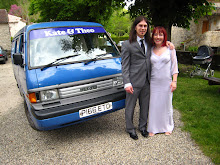
Despite having already visited five countries in 3 weeks (6 if you count the five minutes we were in France) this leg of our Grand European tour feels distinctly less adventurous than our last. This may be for purely superficial reasons - we're used to being on the road now and the novelty of living in a campervan has worn off, while for my part I have been to all five of these countries - Belgium, Luxembourg, The Nertherlands, Germany and Denmark - before. However I think the reasons are more cultural.
Northern Europe simply is not different enough to feel as much as adventure as, say, traveling through Thailand would (though we're guessing here as neither of us have been to Asia). The towns and cities, while beautiful, new and exciting are not alien to us despite the little differences: indeed Ribe in Denmark reminded me strongly of my home town of Cirencester, except with a Viking Museum instead of a Roman one. For all the intricate canal systems, decorous Rathauses and ancient city fortifications we have seen little that we cannot relate back to our English experience, unlike the tiled houses of Portugal, the relics of Moorish Spain or the Roman ruins in Italy and France. The landscapes we have driven through haven't evoked for us a way of life all that different from our own, pretty as there are. In the south there were countless times, in France, Spain and Portugal, when the surrounding countryside and vegetation reminded me strongly of African vistas, while the lack of traffic on the roads (unlike the busy North) increased the sensation of other-worldliness and exploration.
Plus, we have to admit, we're being totally spoiled up here in North Western Europe. We don't just mean Fran and Henning's wonderful hospitality at their flat in Kiel, but in general. Campsites have been cheaper and yet better equipped: showers hot and strong, camp kitchens available for use, and toilet seats and loo paper a given. None of these was guaranteed at campsites further south, even those in Italy and France. Linguistically we've been having no problems either, for even though we speak even less Danish, Dutch and Flemish than we do Spanish and Italian (that's to say none at all) EVERYONE speaks English. We've hardly had to try at all to get by.
So, basically, while we're having a wonderful time and have been to some brilliant places we're not feeling like we're being particularly adventurous at the moment. We're hardly heading up the Inca Trail or even crossing the Carpathians. Still, we'll be in Poland soon. And after that Slovakia and Hungary; if being vegetarian in Hungary isn't an adventure I don't know what is.
Showing posts with label culture. Show all posts
Showing posts with label culture. Show all posts
Saturday, 30 August 2008

Thursday, 26 June 2008
On tourists
Tourists...we're a funny lot, aren't we? Like many a middle class Englisharian I am uncomfortable with the business of being a tourist - it so easily places you in a universe of tackiness and I take on board Jarvis Cocker's pronouncement that "everybody hates a tourist." Growing up in Cornwall has also given me a dread of being instantly identified with "the emmets" - the Cornish word for ants, so generously bestowed by the Duchy's natives on those who butter most of their turnips.
Yes, tourists are big business and places like Cornwall or Bath - both areas where I have lived and/or worked - would not prosper without them. At the same time, as Mr Cocker points out, tourists tend to be despised. Especially foreign tourists.
So here are a few observations on tourists I have made while sightseeing in France (main traps visited: Mont St Michel, Carcassonne, Pont du Gard); Spain (the Bilbao Guggenheim, Salamanca, Seville, Cordoba, the Costa del Sol); Portugal (Porto, Coimbra, Lisbon) and Italy (Rome, San Gimignano, Florence, San Marino...so far).
1. Most tourists are German, Dutch or North American. Apart from on the Costa del Sol, where they're almost one hundred per cent British.
2. A large proportion of tourists only see these incredible cultural hotspots through the lens of their digital cameras.
3. Tourists are seen as fair game to be ripped off by everyone, from third-class, overpriced restaurants, to retailers selling souvenirs of gob-smacking poor taste, the hawkers with their counterfeit handbags, the buskers with their dreadful backing tracks and the (usually Romany) beggars. And let's not forget the living statues, no self-respecting historical centre should be without one.
4. There is a tourist uniform consisting of knee-length shorts, short-sleeved shirts, bum-bags and sensible shoes (usually walking sandals). It is worn by both men and women, who are often hard to tell apart.
5. Even if the above symptoms haven't been noted, the regular unfolding and peering at free city plans should give any hitherto unnoticed tourists away.
6. Most tourists want to experience something "authentic". But ironically, their own presence invariably leads to them getting the exact opposite.
7. Locals are usually most welcoming to tourists in places which receive the least.
8. When it comes to "doing the culture", tourists tend to be incredibly keen to learn as much as possible about the place they're visiting. Consequently, they love multi-lingual, pedagogic guides (especially the sort with commanding voices that stride purposefully to the front of long queues waving an easy-to-spot umbrella); audio guides (so they can wander from exhibit to exhibit with something resembling a large phone clamped to their ear); open-top tour buses (with pre-recorded commentaries) and guide-books.
Yes, I don't like being seen as one of the faceless visiting hordes - but I don't regret joining the throngs to see The Colisseum, The Sistine Chapel, Michaelangelo's David, Seville Cathedral, The Mezquita, Carcassonne citadel or any of the other places we've been to. In fact, I feel privileged, they're all amazing things to have seen. But I really could have done without the crowds, the queues and the con-artists.
Subscribe to:
Posts (Atom)

 Posts

