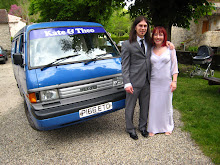

Conversation No 1: Kate and Rosie in the car
R: Hay barcos!
K: Donde? No hay agua aqui.
R: Si. Hay lago.
Conversation No 2: Theo and Roise at home
T: Que hiciste hoy?
R: Fuiste al parque, con mama.
T: Tienes que decir "fui al parque."
R: Fui al parque.
T: Bien. Jugabas sobre los columpios?
R: Y el tobogan!
Conversation No 3: Theo and Rosie in the park.
T: Quieres bajar el tobogan?
R: No, I want to sit on the swing-swing.
T: Quieres jugar sobre el columpio, de acuerdo. Y pues, quererias ir al lago para ver los patos?
R: Go and see the ducks! OK!
It's interesting that Rosie seems to have a worked out that, when in public, it is better to speak English even when spoken to in Spanish, as it increases the likelihood that she will be understood.
Showing posts with label spanish. Show all posts
Showing posts with label spanish. Show all posts
Sunday, 18 March 2012

Saturday, 26 November 2011
look who's talking NOW - by Theo
"All gone! Finished! NOW."
"Mama viene. NOW."
"Mas leche. NOW."
"Carry cuddle! NOW."
"Daddy up! NOW."
"Mas pan! NOW."

Rosie is rather imperative. It's unsurprising as regardless of the language most of the sentences we model for her are imperatives - "come here", "pon lo aqui", "hold my hand". So naturally as she begins to string sentences together from individual words, they are often orders, made with a sense of impatience and awareness that others may not have the same priorities that she clearly gets from her father.
She does descriptions as well, often related to clothing ("slippers off", "lleva gafas", "Rosie tired/cansada") and even has a few anecdotes that, with prompting from Kate, she can recount. One goes like this:
Kate: Rudy (a fellow toddler) tried to cuddle you.
Rosie: Mummy say "No kick!"
It's all astoundingly endearing (she had the museum attendant enraptured by her ability to say "cardie on" at the M Shed) and totally fascinating the way Rosie is acquiring and structuring language. Naturally her English is far more developed than her Spanish; though I suspect this is in part due to the fact she is trying to use verb phrases which is far easier in English ("he/she" form aside, the present tense and imperative are the same) than in Spanish, with its multiple endings and irregularities. For example she has been experimenting with the verb "ser" (to be): sometimes she gets it right by saying (to Kate) "es Papa!" ("it's Dad!"). But when she tells me "soy Papa", that's the wrong form - it's what I would say to her: Rosie needs to say "eres Papa". OK, the English version of this (am/are/is) wouldn't be much easier, but most English verbs don't change so dramatically.
"Mama viene. NOW."
"Mas leche. NOW."
"Carry cuddle! NOW."
"Daddy up! NOW."
"Mas pan! NOW."

Rosie is rather imperative. It's unsurprising as regardless of the language most of the sentences we model for her are imperatives - "come here", "pon lo aqui", "hold my hand". So naturally as she begins to string sentences together from individual words, they are often orders, made with a sense of impatience and awareness that others may not have the same priorities that she clearly gets from her father.
She does descriptions as well, often related to clothing ("slippers off", "lleva gafas", "Rosie tired/cansada") and even has a few anecdotes that, with prompting from Kate, she can recount. One goes like this:
Kate: Rudy (a fellow toddler) tried to cuddle you.
Rosie: Mummy say "No kick!"
It's all astoundingly endearing (she had the museum attendant enraptured by her ability to say "cardie on" at the M Shed) and totally fascinating the way Rosie is acquiring and structuring language. Naturally her English is far more developed than her Spanish; though I suspect this is in part due to the fact she is trying to use verb phrases which is far easier in English ("he/she" form aside, the present tense and imperative are the same) than in Spanish, with its multiple endings and irregularities. For example she has been experimenting with the verb "ser" (to be): sometimes she gets it right by saying (to Kate) "es Papa!" ("it's Dad!"). But when she tells me "soy Papa", that's the wrong form - it's what I would say to her: Rosie needs to say "eres Papa". OK, the English version of this (am/are/is) wouldn't be much easier, but most English verbs don't change so dramatically.
Saturday, 8 October 2011
NO! - by Theo
"No! No! NOOOOOO!"
Yes, Rosie has finally learnt the word "No!" She could of course express a negative opinion beforehand, but up until Friday this was usually done by shaking her head and arms and saying "da da da", which was, frankly, endearingly cute.
There is nothing cute about "No". In fact it is a hideous word. Sadly, of course, it's a very important one, in both English and Spanish. In fact it's probably more important in Spanish, as it's just put in front of the verb for a negative (whereas English puts "not" after) and is used as a general, often affirmative, question (E.g. "Te gusta el parque, no?" - you like the park, don't you?) So, we definitely brought this one on our own heads.
We are now both thinking of as many ways as possible to get "yes" into our sentences.
Yes, Rosie has finally learnt the word "No!" She could of course express a negative opinion beforehand, but up until Friday this was usually done by shaking her head and arms and saying "da da da", which was, frankly, endearingly cute.
There is nothing cute about "No". In fact it is a hideous word. Sadly, of course, it's a very important one, in both English and Spanish. In fact it's probably more important in Spanish, as it's just put in front of the verb for a negative (whereas English puts "not" after) and is used as a general, often affirmative, question (E.g. "Te gusta el parque, no?" - you like the park, don't you?) So, we definitely brought this one on our own heads.
We are now both thinking of as many ways as possible to get "yes" into our sentences.
Thursday, 4 August 2011
Rosie's talk - by Theo (chanelling Pat Hutchins)
Rosie the toddler went for a walk.
She walked through the "parque". Around the "agua". Over the "ball". Past the "doggle-oggle". Through the "door". Under the "bees" and got back in time to shout "dame!"
Rosie's speech is coming along rapidly, in both English and Spanish, from maybe only 10 words at the beginning of July to more than 50 now. She still expresses herself in single words, which are not always used correctly, as can be seen in this video from the morning we left Madrid.
"Dame" ("give me" in Spanish) gets used as a general expression of desire (e.g. "open", "take", "lift") rather than its more specific meaning. Meanwhile, pretty much anything with floppy ears and a tail is a "doggle-oggle" or a "oof-oof" (except for cats which are "miaow-miaows"). It's interesting which language she chooses - for example she says "agua" rather than "water" and "mas" rather than "more" but "please" rather than "por fa'" and "glasses" rather than "gafas". Some words could go either way - "yo-go" could just as easily be "yoghurt" as "yogur". Other words only get used in certain situations - for example, when pretending to answer the phone Rosie will say "si, si, si" but otherwise never comes out with the Spanish for "yes". There doesn't seem to be a pattern however, and so far she hasn't learned many equivalent words in both languages (except Mama/Mummy; Papa/Daddy and usefully, pi-pi/wee-wee and poo-poo/ka-ka). It's funny what words she picks up though - she says "cool" a lot, something she obviously gets from Kate and I, while earlier this evening she clearly articulated something that she definitely hadn't heard us say (ahem): "f*ck it!"
She walked through the "parque". Around the "agua". Over the "ball". Past the "doggle-oggle". Through the "door". Under the "bees" and got back in time to shout "dame!"
Rosie's speech is coming along rapidly, in both English and Spanish, from maybe only 10 words at the beginning of July to more than 50 now. She still expresses herself in single words, which are not always used correctly, as can be seen in this video from the morning we left Madrid.
"Dame" ("give me" in Spanish) gets used as a general expression of desire (e.g. "open", "take", "lift") rather than its more specific meaning. Meanwhile, pretty much anything with floppy ears and a tail is a "doggle-oggle" or a "oof-oof" (except for cats which are "miaow-miaows"). It's interesting which language she chooses - for example she says "agua" rather than "water" and "mas" rather than "more" but "please" rather than "por fa'" and "glasses" rather than "gafas". Some words could go either way - "yo-go" could just as easily be "yoghurt" as "yogur". Other words only get used in certain situations - for example, when pretending to answer the phone Rosie will say "si, si, si" but otherwise never comes out with the Spanish for "yes". There doesn't seem to be a pattern however, and so far she hasn't learned many equivalent words in both languages (except Mama/Mummy; Papa/Daddy and usefully, pi-pi/wee-wee and poo-poo/ka-ka). It's funny what words she picks up though - she says "cool" a lot, something she obviously gets from Kate and I, while earlier this evening she clearly articulated something that she definitely hadn't heard us say (ahem): "f*ck it!"
Wednesday, 29 June 2011
Things to miss about Madrid - By Kate
After two and a half years of life as Madrileños, our flat is now empty of our possessions and we've said our goodbyes to the friends we've made here and we're en route to board a boat for Blighty.
Not surprisingly, I'm consumed with mixed feelings. I'm looking forward to living closer to our families and our old friends in England again. The ease of living in a country where I can speak and understand the language is definitely something to be appreciated. And having "the knowledge" of a place - all those little details that make life easier, which has to be learned from scratch in a new location - is something I now appreciate like never before.
But there are plenty of things I shall miss about living in Madrid and indeed Spain. Here are the main ones in no particular order:
The sunshine. There's a lot of it. Sometimes too much. But especially during Spring and late Autumn, it's wonderful.
The fresh fruit. It's great to be able to eat things like mangoes and Kiwi fruit, knowing they haven't been imported. And I shall really miss things like brevas (a large, early type of fig) and picotas (wonderfully sweet dark cherries).
The Hispanic love of babies and small children. Everywhere you go your little cherubs are routinely admired and welcomed by people of all ages and in all places. Where many in the UK tend to assume a slightly pained expression suggesting a bad smell under their nose when they catch sight of children, Latinos smile indulgently and affably chub their cheeks. Even tantrums are greeted with sympathy tinted with the knowing amusement. The breathtaking number of children's play parks. The generosity of spirit extended towards little nippers isn't confined to the general public, Spain's local authorities also make sure their younger citizens are amply provided with places to have fun and let off steam.
The easy give-and-take of high-density living. Take noise, for example. We've never once experienced any dubiousness towards the inevitable noise made by Rosie both as a baby and an energetic toddler. In fact, one set of neighbours came round specifically to tell us not to worry about it. When we've wanted an early night and the sound of loud TVs or music have penetrated our flat, a simple knock on a wall, ceiling or window or (in a couple of cases) a polite request to turn things down have yielded a generally good-natured and prompt response. Why do so many people in the UK take umbrage if requested to keep it down as a mark of consideration for those who live nearby?
Friendly neighbours. Related to the above. We hadn't been living here long before we knew the names of those also living on our floor and were on "que tal?" terms with many more. And although they don't know us well, many have expressed regret when we've told them we're leaving.
The drinking culture. Spaniards love to drink, especially en masse and for extended periods of time. But they don't usually drink to get drunk and it's very unusual for people to show aggression after they've had a few. I can walk through Madrid's busiest nightlife areas on a Friday or Saturday night, surrounded by people drinking and not feel the slightest fear that a fight may break out near me or I might get accosted by an inebriated arsehole who can't see straight. You can't say the same thing about many of the UK's towns and cities, unfortunately.
The public transport. Madrid's system of underground trains and bus routes is excellent. Generally clean, air-conditioned, inexpensive and very frequent. AND the bus drivers don't throw a hissy fit when you board their vehicle pushing a baby buggy.
Non-homogenous high streets. There are still large numbers of independent specialist retailers in Spain and each barrio has its own particular character.
The cafe/bar culture. With lots of outdoor seating and food served all day. Plus the free tapas, of course, meaning ordering food is often not necessary. The trees. Madrid is the most wooded capital city in the world - thankfully, the shade provided is desperately needed during the summer months. Mind you, it does make for an awful lot of municipal leaf-blowing during the winter...
Cheap but stylish women's hair-cuts. There are various things that cost less in Spain compared with the UK, but this is the one where the gap seems to be biggest. €12.50 for a cut and blow-dry....
The sense of satisfaction the comes from communicating in non-mother tongue. The flip side of struggling to understand and be understood. One source of regret is that we're leaving just as I was starting to get a handle on Spanish to the extent that I can at least have a basic conversation with someone.
Naturally, there are aspects of life in Madrid I definitely won't miss:
The summer heat. It quickly becomes unbearable and despite awnings, shutters and ceiling fans, sleep is a restless business when temperatures hit the high thirties. On the other hand, laundry is dry within a few hours of being hung out, so it's not all bad.
Language befuddlement. I've still got a distance to travel before I'm truly comfortable operating in Spanish. It's frustrating to be unable to express myself to someone or to not understand what they're telling me. I can "get by" in Spanish, but to my regret, that's my current limit.
Doggy do's. Urban Spanish dog-owners are somewhat behind their British counterparts when it comes to cleaning up after the family pet. Apparently, they're a lot better than they used to be - which makes me shudder to think what state the streets were in a few years ago.
Over-packaging. Especially fruit and veg. Shops are now beginning to be less generous when it comes to dispensing plastic bags, but there's a way to go yet.
The paucity of charity shops. We found one not far from our barrio, but they are few and far between. Second-hand shops do exist, but the time and energy needed to dig through the jumbled heaps of unsorted clothes to find a decent bargain is usually more than I'm willing to give.
Screeching washing lines. Aerial clothes lines tend to operate on a pulley system and unless you're an abseiler, its very hard to lubricate the metal wheels, which get steadily more oxidised as the years pass. Therefore an alarming series of banshee howls as someone hangs out their laundry is inevitable. And responsible for many a disrupted nap (in my case - Rosie seems to be able to sleep through them, thankfully).
One thing's for sure - as a first experience of living in a country other than the one where I was born it's been a fantastic adventure. I return with a wealth of experience I would never have otherwise had. Not to mention as mother of a daughter who was conceived and born in Madrid. That's an incredible thing in itself.
Will we come back to Spain to live? Perhaps. Certainly, our sojourn here has done nothing to put us off.
Meanwhile, we will do our best to keep our Spanish alive and encourage Rosie to grow up with a grasp of the language from the country of her birth.
Not surprisingly, I'm consumed with mixed feelings. I'm looking forward to living closer to our families and our old friends in England again. The ease of living in a country where I can speak and understand the language is definitely something to be appreciated. And having "the knowledge" of a place - all those little details that make life easier, which has to be learned from scratch in a new location - is something I now appreciate like never before.
But there are plenty of things I shall miss about living in Madrid and indeed Spain. Here are the main ones in no particular order:
The sunshine. There's a lot of it. Sometimes too much. But especially during Spring and late Autumn, it's wonderful.
The fresh fruit. It's great to be able to eat things like mangoes and Kiwi fruit, knowing they haven't been imported. And I shall really miss things like brevas (a large, early type of fig) and picotas (wonderfully sweet dark cherries).
The Hispanic love of babies and small children. Everywhere you go your little cherubs are routinely admired and welcomed by people of all ages and in all places. Where many in the UK tend to assume a slightly pained expression suggesting a bad smell under their nose when they catch sight of children, Latinos smile indulgently and affably chub their cheeks. Even tantrums are greeted with sympathy tinted with the knowing amusement.
 The breathtaking number of children's play parks. The generosity of spirit extended towards little nippers isn't confined to the general public, Spain's local authorities also make sure their younger citizens are amply provided with places to have fun and let off steam.
The easy give-and-take of high-density living. Take noise, for example. We've never once experienced any dubiousness towards the inevitable noise made by Rosie both as a baby and an energetic toddler. In fact, one set of neighbours came round specifically to tell us not to worry about it. When we've wanted an early night and the sound of loud TVs or music have penetrated our flat, a simple knock on a wall, ceiling or window or (in a couple of cases) a polite request to turn things down have yielded a generally good-natured and prompt response. Why do so many people in the UK take umbrage if requested to keep it down as a mark of consideration for those who live nearby?
Friendly neighbours. Related to the above. We hadn't been living here long before we knew the names of those also living on our floor and were on "que tal?" terms with many more. And although they don't know us well, many have expressed regret when we've told them we're leaving.
The drinking culture. Spaniards love to drink, especially en masse and for extended periods of time. But they don't usually drink to get drunk and it's very unusual for people to show aggression after they've had a few. I can walk through Madrid's busiest nightlife areas on a Friday or Saturday night, surrounded by people drinking and not feel the slightest fear that a fight may break out near me or I might get accosted by an inebriated arsehole who can't see straight. You can't say the same thing about many of the UK's towns and cities, unfortunately.
The public transport. Madrid's system of underground trains and bus routes is excellent. Generally clean, air-conditioned, inexpensive and very frequent. AND the bus drivers don't throw a hissy fit when you board their vehicle pushing a baby buggy.
Non-homogenous high streets. There are still large numbers of independent specialist retailers in Spain and each barrio has its own particular character.
The cafe/bar culture. With lots of outdoor seating and food served all day. Plus the free tapas, of course, meaning ordering food is often not necessary.
 The trees. Madrid is the most wooded capital city in the world - thankfully, the shade provided is desperately needed during the summer months. Mind you, it does make for an awful lot of municipal leaf-blowing during the winter...
Cheap but stylish women's hair-cuts. There are various things that cost less in Spain compared with the UK, but this is the one where the gap seems to be biggest. €12.50 for a cut and blow-dry....
The sense of satisfaction the comes from communicating in non-mother tongue. The flip side of struggling to understand and be understood. One source of regret is that we're leaving just as I was starting to get a handle on Spanish to the extent that I can at least have a basic conversation with someone.
Naturally, there are aspects of life in Madrid I definitely won't miss:
The summer heat. It quickly becomes unbearable and despite awnings, shutters and ceiling fans, sleep is a restless business when temperatures hit the high thirties. On the other hand, laundry is dry within a few hours of being hung out, so it's not all bad.
Language befuddlement. I've still got a distance to travel before I'm truly comfortable operating in Spanish. It's frustrating to be unable to express myself to someone or to not understand what they're telling me. I can "get by" in Spanish, but to my regret, that's my current limit.
Doggy do's. Urban Spanish dog-owners are somewhat behind their British counterparts when it comes to cleaning up after the family pet. Apparently, they're a lot better than they used to be - which makes me shudder to think what state the streets were in a few years ago.
Over-packaging. Especially fruit and veg. Shops are now beginning to be less generous when it comes to dispensing plastic bags, but there's a way to go yet.
The paucity of charity shops. We found one not far from our barrio, but they are few and far between. Second-hand shops do exist, but the time and energy needed to dig through the jumbled heaps of unsorted clothes to find a decent bargain is usually more than I'm willing to give.
Screeching washing lines. Aerial clothes lines tend to operate on a pulley system and unless you're an abseiler, its very hard to lubricate the metal wheels, which get steadily more oxidised as the years pass. Therefore an alarming series of banshee howls as someone hangs out their laundry is inevitable. And responsible for many a disrupted nap (in my case - Rosie seems to be able to sleep through them, thankfully).
One thing's for sure - as a first experience of living in a country other than the one where I was born it's been a fantastic adventure. I return with a wealth of experience I would never have otherwise had. Not to mention as mother of a daughter who was conceived and born in Madrid. That's an incredible thing in itself.
Will we come back to Spain to live? Perhaps. Certainly, our sojourn here has done nothing to put us off.
Meanwhile, we will do our best to keep our Spanish alive and encourage Rosie to grow up with a grasp of the language from the country of her birth.
Monday, 24 January 2011
Learning the lingo By Kate
The other day Theo chided me gently on not making enough effort to improve my Spanish. With complete justification. I'm making virtually no effort at all. Oh yes, I half-listen to Spanish talk radio when I'm in the kitchen and I chat with our Hispanic friends and neighbours, but my understanding of the language is intermittent at best and my speech is akin to a toddler-age child.
My reply was that I was busy learning another new language and Spanish had been squeezed out by my beleaguered brain - or at least, severely relegated. That other new language is called Motherhood.
Then I thought about it some more. Yes, as a metaphor it's not bad, but it doesn't go far enough. I'm not just learning a new language. I'm learning to find my way through a new foreign country.
It's challenging, stimulating, constantly changing, exhausting, stressful, hilarious and highly rewarding. I get lost and take wrong turnings all the time. I try and consult a map, only to find I'm holding it upside down. New vocabulary like "sleep regression" and "snotsucker" have to be learned and I spend many hours scouring text-books for clues to the grammatical rules. Only to find there aren't any.
Suddenly, the myriad Spanish verb endings seem like a walk in the park.
My reply was that I was busy learning another new language and Spanish had been squeezed out by my beleaguered brain - or at least, severely relegated. That other new language is called Motherhood.
Then I thought about it some more. Yes, as a metaphor it's not bad, but it doesn't go far enough. I'm not just learning a new language. I'm learning to find my way through a new foreign country.
It's challenging, stimulating, constantly changing, exhausting, stressful, hilarious and highly rewarding. I get lost and take wrong turnings all the time. I try and consult a map, only to find I'm holding it upside down. New vocabulary like "sleep regression" and "snotsucker" have to be learned and I spend many hours scouring text-books for clues to the grammatical rules. Only to find there aren't any.
Suddenly, the myriad Spanish verb endings seem like a walk in the park.
Friday, 31 December 2010
the perils of not having a Spanish keyboard - by Theo
Unlike French computer keyboards, Spanish ones are basically the same as English ones, which is generally helpful. However, when writing in Spanish, our English Mac Book is deficient in two important ways.
Spanish has two special characters. The first, the tilde, is an accent. While it doesn't change the sound of the vowel it marks which syllable should be stressed in words that don't follow the usual rules of pronunciation. As a non-native speaker I find this extremely helpful; pronunciation (even in English) has never been my strong suit. So, if it's just to do with how you speak Spanish, should it matter whether you include the tilde in written Spanish? Often it doesn't, but sometimes the tilde is the only indication of a change of tense. For example, hable means "he speaks" while hablé means "I spoke", hablará means "he will speak" while hablara means "he spoke (subjunctive)". So, out of context, the lack of a tilde can change the meaning. (Compare this to the English verb "read", which looks the same in both present and past forms, but is pronounced differently in each case.)
However it's the second Spanish special character that really causes problems. It's the 'ñ', pronounced n-ye, and often found with its own separate listing in Spanish dictionaries. As such using an 'n' instead of an 'ñ', a completely different letter, changes the meaning of the word entirely. This is particularly a problem around New Year when wishing Spanish friends a Happy New Year electronically; año means "year" while ano means "anus". Much copying and pasting individual 'ñ's from the El Pais website is therefore required.
So, Happy Anus Everyone!!
Lots of love and thanks for reading - we wish you love, peace and happiness for 2011!
Theo, Kate & Rosie x
Spanish has two special characters. The first, the tilde, is an accent. While it doesn't change the sound of the vowel it marks which syllable should be stressed in words that don't follow the usual rules of pronunciation. As a non-native speaker I find this extremely helpful; pronunciation (even in English) has never been my strong suit. So, if it's just to do with how you speak Spanish, should it matter whether you include the tilde in written Spanish? Often it doesn't, but sometimes the tilde is the only indication of a change of tense. For example, hable means "he speaks" while hablé means "I spoke", hablará means "he will speak" while hablara means "he spoke (subjunctive)". So, out of context, the lack of a tilde can change the meaning. (Compare this to the English verb "read", which looks the same in both present and past forms, but is pronounced differently in each case.)
However it's the second Spanish special character that really causes problems. It's the 'ñ', pronounced n-ye, and often found with its own separate listing in Spanish dictionaries. As such using an 'n' instead of an 'ñ', a completely different letter, changes the meaning of the word entirely. This is particularly a problem around New Year when wishing Spanish friends a Happy New Year electronically; año means "year" while ano means "anus". Much copying and pasting individual 'ñ's from the El Pais website is therefore required.
So, Happy Anus Everyone!!
Lots of love and thanks for reading - we wish you love, peace and happiness for 2011!
Theo, Kate & Rosie x
Sunday, 5 December 2010
Spanish lessons - by Theo
People often ask, with the full range of possible motivations and insinuations, why we moved to Madrid. (Why!?!) The answer is rather simple: because I wanted to learn Spanish. OK, there's more to it than that, and it wasn't just my decision, but moving to Spain to learn Spanish had been a long-standing ambition of mine that Kate, thankfully, was happy to go along with.
So here we are. In Spain. That's part 1 sorted. Now, part 2 - the actual learning. It was all going pretty well until Jan 2010, with Kate and I going regularly to lessons, but then something happened, I can't quite remember what around January this year. We just stopped. I thought that maybe, given we now had a solid grounding, we would just cruise along, slotting new vocabulary and idioms in to the grammatical framework we had acquired. However, by the end of the summer it was clear that this simply wasn't happening. So, I began to form a plan.
The problem with lessons had been that the ones we'd gone to were always in the morning, at around 10, finishing at 12, a good 45 minutes journey from our flat. Given that I was now working until 9 every night, this made for a long day, a rushed lunch and little time with Kate and Rosie. What would be great would be to be able to have my Spanish lessons at my place of work, immediately before I started work. That way it would be just a case of going into work a little earlier. My boss had no objections to me using a room there, provided one was free. So far so good; now just to work out how to pay for it.
Spanish teachers - like English teachers - are pretty thick on the ground here in Madrid. However, they also charge about the same - €20/hour more or less - so, unless I suddenly won El Gordo (the Spanish lottery) I was going to have to find some fellow students to split the cost with. So off I went on a recruitment drive among my fellow teachers at the two branches of the English Language Academy where I work. I was thrilled to find that at least 14 of my colleagues were interested; now came the headache of timetabling and level testing. Tuesday and Thursday, at my branch, from 1pm until 2.30pm was my ideal time; naturally then, after taking on board everybody else's preferences, the advanced class ended up being on Monday and Wednesday at 12 at the other branch. Oh well.
So, I now had my Spanish classes, at the outrageously cheap rate of €5 per 90 minute class. Bargain. The teacher was a friend we'd met while he had been training to become a teacher - we'd been his guinea pigs as it were. We had a space to hold the classes. All good. However, I also now found that I had, along the way ended up with responsibility for a beginners' group as well. Well, naturally - they didn't speak Spanish, so I had to do the negotiations for them.
We're now heading into our third month of classes, and they're going really well. We've reviewed past tenses, which are often confusing, and prepositions, which are always confusing. Next we'll be tackling the subjunctive. However the content of the classes has been the least of my concerns; it's keeping people at them that's been the problem. As the cost is split between those attending, if some students drop out it makes the class more expensive for those who stay on. This has become a problem, although not in the way I expected...
Among the other teachers who come to the advanced class with me, two have Spanish boyfriends. Another spent his Erasmus year in Granada, while another has been in Spain for over 3 years. If anyone was going to drop out of the classes, I would have expected it to have been one of them - after all they are already pretty good. But instead it's been the beginners that have been dropping like flies - from an original 7, they are now down to 3. I don't understand it - do they not plan to learn Spanish at all?! Perhaps not. Several have complained that they can't afford it, which I again fail to understand - we are all earning the same, yet they'll be paying less rent (living in shared flats) and don't have a wife and child to support. It's not like they'll find classes any cheaper elsewhere. Oh well; si los de mi clases seguen, me da igual.
So here we are. In Spain. That's part 1 sorted. Now, part 2 - the actual learning. It was all going pretty well until Jan 2010, with Kate and I going regularly to lessons, but then something happened, I can't quite remember what around January this year. We just stopped. I thought that maybe, given we now had a solid grounding, we would just cruise along, slotting new vocabulary and idioms in to the grammatical framework we had acquired. However, by the end of the summer it was clear that this simply wasn't happening. So, I began to form a plan.
The problem with lessons had been that the ones we'd gone to were always in the morning, at around 10, finishing at 12, a good 45 minutes journey from our flat. Given that I was now working until 9 every night, this made for a long day, a rushed lunch and little time with Kate and Rosie. What would be great would be to be able to have my Spanish lessons at my place of work, immediately before I started work. That way it would be just a case of going into work a little earlier. My boss had no objections to me using a room there, provided one was free. So far so good; now just to work out how to pay for it.
Spanish teachers - like English teachers - are pretty thick on the ground here in Madrid. However, they also charge about the same - €20/hour more or less - so, unless I suddenly won El Gordo (the Spanish lottery) I was going to have to find some fellow students to split the cost with. So off I went on a recruitment drive among my fellow teachers at the two branches of the English Language Academy where I work. I was thrilled to find that at least 14 of my colleagues were interested; now came the headache of timetabling and level testing. Tuesday and Thursday, at my branch, from 1pm until 2.30pm was my ideal time; naturally then, after taking on board everybody else's preferences, the advanced class ended up being on Monday and Wednesday at 12 at the other branch. Oh well.
So, I now had my Spanish classes, at the outrageously cheap rate of €5 per 90 minute class. Bargain. The teacher was a friend we'd met while he had been training to become a teacher - we'd been his guinea pigs as it were. We had a space to hold the classes. All good. However, I also now found that I had, along the way ended up with responsibility for a beginners' group as well. Well, naturally - they didn't speak Spanish, so I had to do the negotiations for them.
We're now heading into our third month of classes, and they're going really well. We've reviewed past tenses, which are often confusing, and prepositions, which are always confusing. Next we'll be tackling the subjunctive. However the content of the classes has been the least of my concerns; it's keeping people at them that's been the problem. As the cost is split between those attending, if some students drop out it makes the class more expensive for those who stay on. This has become a problem, although not in the way I expected...
Among the other teachers who come to the advanced class with me, two have Spanish boyfriends. Another spent his Erasmus year in Granada, while another has been in Spain for over 3 years. If anyone was going to drop out of the classes, I would have expected it to have been one of them - after all they are already pretty good. But instead it's been the beginners that have been dropping like flies - from an original 7, they are now down to 3. I don't understand it - do they not plan to learn Spanish at all?! Perhaps not. Several have complained that they can't afford it, which I again fail to understand - we are all earning the same, yet they'll be paying less rent (living in shared flats) and don't have a wife and child to support. It's not like they'll find classes any cheaper elsewhere. Oh well; si los de mi clases seguen, me da igual.
Wednesday, 13 October 2010
Lost in Translation - by Theo
Yesterday was the Dia de Hispanidad, which does lose a little something in translation, and a national holiday here in Spain and elsewhere in the Spanish speaking world - given the events of today I wonder whether there will soon be another national holiday in Chile. But that's another story....
Kate and I had a lazy day off, made extra lazy by the fact that Kate had arranged (as an extra birthday present) for our Canadian friend Miriam to take Rosie out for a walk for a couple of hours in the afternoon so we could, for once, enjoy a siesta un-interrupted. Bliss! The laziness continued into the evening and, after dinner in front of an episode of the Wire, we were contemplating bed at around 9pm when the phone rang.
It was my friend and former student Juan. Juan works as a lawyer at a multinational financial firm. He speaks perfect French and excellent English but he is not a translator. However, at the last minute, despite it being a holiday, his firm had dumped a 10 page legal document on him and asked him to translate it into English by the next morning. He was at a loss and wanted my help. Seeing as his English is better than my Spanish I was doubtful about how much help I could be, but as he sounded so desperate I said he could come round - provided he bring some beer.
In the end I quite enjoyed it. Juan had done most of the work, I just needed to check it over. The original Spanish document was dull enough, but was also surprisingly easy to understand as it was very formal and lacked the idioms and colloquialisms that are often confusing in everyday language. In addition many of the Spanish financial terms were exactly the same as the English - take a wild guess what "liquidacion" or "deducion" mean - which of course were easier for me (working Spanish to English) than Juan, who was less confident about the English vocabulary.
Anyway we got it done. Mind you, if you hear of any legal or financial scandals in Spain involving mistranslations, then you'll know who to blame!!
Kate and I had a lazy day off, made extra lazy by the fact that Kate had arranged (as an extra birthday present) for our Canadian friend Miriam to take Rosie out for a walk for a couple of hours in the afternoon so we could, for once, enjoy a siesta un-interrupted. Bliss! The laziness continued into the evening and, after dinner in front of an episode of the Wire, we were contemplating bed at around 9pm when the phone rang.
It was my friend and former student Juan. Juan works as a lawyer at a multinational financial firm. He speaks perfect French and excellent English but he is not a translator. However, at the last minute, despite it being a holiday, his firm had dumped a 10 page legal document on him and asked him to translate it into English by the next morning. He was at a loss and wanted my help. Seeing as his English is better than my Spanish I was doubtful about how much help I could be, but as he sounded so desperate I said he could come round - provided he bring some beer.
In the end I quite enjoyed it. Juan had done most of the work, I just needed to check it over. The original Spanish document was dull enough, but was also surprisingly easy to understand as it was very formal and lacked the idioms and colloquialisms that are often confusing in everyday language. In addition many of the Spanish financial terms were exactly the same as the English - take a wild guess what "liquidacion" or "deducion" mean - which of course were easier for me (working Spanish to English) than Juan, who was less confident about the English vocabulary.
Anyway we got it done. Mind you, if you hear of any legal or financial scandals in Spain involving mistranslations, then you'll know who to blame!!
Saturday, 2 October 2010
Fluency Schmuency - by Theo
Coming from a country with one of the lowest rates of knowledge of a second language in Europe, if not the world, it's hardly surprising that we should misunderstand what it is to truly master a foreign language. In England we talk about being "fluent" in a language, usually equating this with having complete control over said tongue.
Not so. Fluent, from fluid, simply means to be able to talk without hesitations or significant pauses in a smooth stream of words. Your pronunciation may be atrocious, you might put the emphasis in totally the wrong places, your prose could be littered with errors and you might be completely incapable of understanding the response you elicit. Doesn't matter; you're fluent, and as far as most English people are concerned, that's enough. Forget the fact that native speakers might be completely confused by your gnomic (yet, fluent) utterances, we feel we've done our bit by blurting out our foreign phrases in one, smooth go.
Before moving to Spain I was just as guilty of this, equating fluency with being able to 'speak' a language (also a bad term - after all it's not much good being able to 'speak' a language if you can't understand the response). In fact, upon taking one of my first classes for Spanish learners of English and finding all my students to be incredibly fluent and generally faultless in English, I was astounded to discover that they were studying for the Cambridge First Certificate in English. The First Certificate. There are two more, higher level exams after that, Advanced and Proficiency. As a rookie teacher I struggled to imagine what more these almost word-perfect teenagers had to learn about the English language. I mean they were fluent, what more did we want?
My own learning experience of Spanish and my continual struggles with French have enlightened me somewhat. I am now 'fluent' in Spanish, though I'm still a long way off being word-perfect, or understanding the majority of things said to me in Spanish. Hopefully though, after 10 months of intermittent self-study, I'll be getting back to Spanish lessons and striving to improve. Or rather I'll be bringing Spanish lessons to me, having persuaded many of my teaching colleagues to band together for an in-house teacher. Meanwhile, having been allotted 4 classes of Proficiency level students in this academic year's timetable, I'll be finding out exactly what more there is to learn about English beyond fluency.
Not so. Fluent, from fluid, simply means to be able to talk without hesitations or significant pauses in a smooth stream of words. Your pronunciation may be atrocious, you might put the emphasis in totally the wrong places, your prose could be littered with errors and you might be completely incapable of understanding the response you elicit. Doesn't matter; you're fluent, and as far as most English people are concerned, that's enough. Forget the fact that native speakers might be completely confused by your gnomic (yet, fluent) utterances, we feel we've done our bit by blurting out our foreign phrases in one, smooth go.
Before moving to Spain I was just as guilty of this, equating fluency with being able to 'speak' a language (also a bad term - after all it's not much good being able to 'speak' a language if you can't understand the response). In fact, upon taking one of my first classes for Spanish learners of English and finding all my students to be incredibly fluent and generally faultless in English, I was astounded to discover that they were studying for the Cambridge First Certificate in English. The First Certificate. There are two more, higher level exams after that, Advanced and Proficiency. As a rookie teacher I struggled to imagine what more these almost word-perfect teenagers had to learn about the English language. I mean they were fluent, what more did we want?
My own learning experience of Spanish and my continual struggles with French have enlightened me somewhat. I am now 'fluent' in Spanish, though I'm still a long way off being word-perfect, or understanding the majority of things said to me in Spanish. Hopefully though, after 10 months of intermittent self-study, I'll be getting back to Spanish lessons and striving to improve. Or rather I'll be bringing Spanish lessons to me, having persuaded many of my teaching colleagues to band together for an in-house teacher. Meanwhile, having been allotted 4 classes of Proficiency level students in this academic year's timetable, I'll be finding out exactly what more there is to learn about English beyond fluency.
Sunday, 25 April 2010
spanish blog
Por cierto, es un decision un poco raro - escribir un blog en espanol cuando la mayoria de la gente que leer este blog son ingleses. No obstante, recientemente no he progresado mucho en espanol. Es facile a entender por que - Rosie! En 2009 fuimos a clases de espanol casi cada dia, pero jamas en 2010. Por lo tanto quiero escribir algunos blogs en espanol para practicar y, espero, desarrollara mi espanol. Claro que habra muchas faltas, pero si es mejor que mi primero blog en espanol voy a ser contento! Bueno, pero por que empezo ahora?
Cuando mis padres visitaron hablabamos sobre mis aficiones que tenia en mi juventud. No tenia niguno por mucho tiempo. Esta toma de consciencia me llevo a un otro; que sin rutina no tengo la disciplina personal necessaria para mantener un interes. He ya sentido que estaba vago y perdia el tiempo - fuera de mi trabajo no tengo actividades regulares. Entonces hice una resolucion - yo voy a empezar una rutina semanal de dos horas de espanol, una hora de tocar la guitarra y salir a correr cuatro veces.
Despues dos semanas la ultima ha estado lo mas facil. He comprado nuevos zapatos y corro los 3.5 kilometros desde mi trabajo hasta mi casa lunes a jueves. Es mas rapido que el autobus, pero creo que esto es mas una critica al autobus que un cumplido para mi. Hay una ruta variado, con calles grandes y pequenas, una parque y la Plaza del Toros. En mi opinion es un grande pena que un edificio tan guapo podria ser para un espectaculo tan cruel.
Por otro lado, buscando tiempo para tocar la guitarra o aprender espanol es mucho mas dificil. Entonces, este blog... por favor, si mi equivoco, corrigeme!
Cuando mis padres visitaron hablabamos sobre mis aficiones que tenia en mi juventud. No tenia niguno por mucho tiempo. Esta toma de consciencia me llevo a un otro; que sin rutina no tengo la disciplina personal necessaria para mantener un interes. He ya sentido que estaba vago y perdia el tiempo - fuera de mi trabajo no tengo actividades regulares. Entonces hice una resolucion - yo voy a empezar una rutina semanal de dos horas de espanol, una hora de tocar la guitarra y salir a correr cuatro veces.
Despues dos semanas la ultima ha estado lo mas facil. He comprado nuevos zapatos y corro los 3.5 kilometros desde mi trabajo hasta mi casa lunes a jueves. Es mas rapido que el autobus, pero creo que esto es mas una critica al autobus que un cumplido para mi. Hay una ruta variado, con calles grandes y pequenas, una parque y la Plaza del Toros. En mi opinion es un grande pena que un edificio tan guapo podria ser para un espectaculo tan cruel.
Por otro lado, buscando tiempo para tocar la guitarra o aprender espanol es mucho mas dificil. Entonces, este blog... por favor, si mi equivoco, corrigeme!
Friday, 13 November 2009
Português próxima
I've just finished reading Night Train to Lisbon by Pascal Mercier, which I really enjoyed. Essentially a story of a teacher of ancient languages voyage of self-discovery triggered by a chance meeting with an unnamed Portuguese woman it was very enjoyable and thought provoking, putting me in mind of Sophie's World (though without the massive plot twist). The book is littered with quotations and phrases in Portuguese, which I was very pleasantly surprised to find I mostly understood - most of the nouns are similar to their Spanish counterparts, while the verbs and articles follow the same rules as other Romance languages. Pronunciation is the major difference. Anyway, I think I'll make a start learning Portuguese next. When I've finally mastered Spanish of course. So 2020 then.
Actually I'm feeling more and more confident about Spanish. I still litter my conversation with mistakes, but I'm generally understood and I usually understand. As we've been negotiating our unborn child's process through Madrid's health service we've both been called upon to engage with Spanish with a greater frequency than before, while hanging out with some of my former students (who have a lower level of English than our Pueblo Ingles friends) has meant we socialise more and more in the language. We've also been going along to free lessons at International House again - really these are training classes for new Spanish teachers, but the need guinea pigs, so we get them free. We've made some good friends among some of the regular attendees, although why there aren't more people taking advantage of them I don't know; often there's been just 3 of us in a class. Still, it means we get loads of attention.
Actually I'm feeling more and more confident about Spanish. I still litter my conversation with mistakes, but I'm generally understood and I usually understand. As we've been negotiating our unborn child's process through Madrid's health service we've both been called upon to engage with Spanish with a greater frequency than before, while hanging out with some of my former students (who have a lower level of English than our Pueblo Ingles friends) has meant we socialise more and more in the language. We've also been going along to free lessons at International House again - really these are training classes for new Spanish teachers, but the need guinea pigs, so we get them free. We've made some good friends among some of the regular attendees, although why there aren't more people taking advantage of them I don't know; often there's been just 3 of us in a class. Still, it means we get loads of attention.
Saturday, 20 June 2009
swimming and studying
My plan to spend every morning/lunchtime last week in the pool was scuppered by an e mail Kate received on Tuesday night. Anabel, the training coordinator at International House, needed some extra students for her course for new Spanish teachers, with the lessons (which would be free for us) running from 9.30am until 11.30am every morning - were we available?
It was very nice of her to think of us - we'd obviously built up a reputation as 'good' students - but I was a little confused as at the end of the last course in May she had told us that there weren't any more until July. When we turned up on Thursday, it became clear that what she had meant was - "there weren't any more for your level." Kate and I, previously among the best students in our Spanish classes, are now firmly chasing the game, having joined a class that is clearly more advanced than our last.
Our very first exercise centered around a tense we'd never come across before, the pluscuamperfecto, which is formed by using the imperfect tense of haber as an auxiliary verb with the main verb in past participle. As this is basically the same as French, and as its usage is the same as the English past perfect, we were quickly able to grasp the salient points, though our usage continued to be clumsy as we'd only just got the hang of past participles, preterito and the imperfect tense, let alone using them in unison. Confused? So were we.
Here's an example:
Cuando llegre al stadio, el partido ya habia empezado = (when I arrived at the stadium, the match had already started.)
'llegre' here is in the preterito indefinido, the Spanish equivalent of the English present simple, 'habia empezado' being the pluscuamperfecto of empezar (to start); like the English past perfect its used to talk about a finished action in the past that had happened before something else happened. So in order to use this tense correctly we had to remember the endings and formation of three other tenses!
Later in the class we were thrown into verb collocations - which verbs are followed by an infinitive and which by a gerund. Seeing as we've never been taught how to form the gerund, this was definitely asking us to run before we can walk.... we're just about keeping up! However, I haven't let all of this set me back; I've still managed to go swimming 6 days out of 7 this week!
Our very first exercise centered around a tense we'd never come across before, the pluscuamperfecto, which is formed by using the imperfect tense of haber as an auxiliary verb with the main verb in past participle. As this is basically the same as French, and as its usage is the same as the English past perfect, we were quickly able to grasp the salient points, though our usage continued to be clumsy as we'd only just got the hang of past participles, preterito and the imperfect tense, let alone using them in unison. Confused? So were we.
Here's an example:
Cuando llegre al stadio, el partido ya habia empezado = (when I arrived at the stadium, the match had already started.)
'llegre' here is in the preterito indefinido, the Spanish equivalent of the English present simple, 'habia empezado' being the pluscuamperfecto of empezar (to start); like the English past perfect its used to talk about a finished action in the past that had happened before something else happened. So in order to use this tense correctly we had to remember the endings and formation of three other tenses!
Later in the class we were thrown into verb collocations - which verbs are followed by an infinitive and which by a gerund. Seeing as we've never been taught how to form the gerund, this was definitely asking us to run before we can walk.... we're just about keeping up! However, I haven't let all of this set me back; I've still managed to go swimming 6 days out of 7 this week!
Sunday, 7 June 2009
Ingredients for a classic Madrid weekend
1. Language practice with wine and food - invite Spanish and Venezualan friends home for traditional English cuisine (curry)
2. Visit the enormous Madrid book fair in Retiro park - tomes in dozens of languages, catering to tastes ranging from obscure Manga to far left Argentinian political polemic and pretty much everything else you can think of. Note to self - next time don't leave it until twenty minutes before closing time to try and browse the 357 stalls.
3. Drink coffee in Plaza Chueca - Chueca is Madrid's gay district and if a visitor couldn't work that out from the number of same-sex couples ambling hand-in-hand, the barrio's mixture of saunas and shoe shops would probably give it away. We sat on a bar terraza sipping our drinks watching local colour in the form of a young man who looked like he'd been kicked out of the house by his boyfriend that morning, hit the bottle in despair and passed out on a stone bench at the side of the plaza. As we watched, he crumpled gently onto the ground among his flowing scarves and other belongings and was covered with a coat by a solicitous passer-by. "He's been sleeping there since this morning," she told a table of lads who were also enjoying the spectacle.
4. Have a cana in La Latina. We avoided the temptation to go inside the dingy-looking but gloriously named Latina Turner and opted for another of the many funky bars in the area...
5... then ended up in La Alhambra in the Sevilla area, an authentically feeling Spanish bar, for another cana and some patatas con salsas. 6. Watch the Madrid version of Critical Mass swarm around the glorieta beside Metro La Latina - as it was Saturday evening, it didn't cause much of a traffic gridlock, but there was a big chequered flag, some colourful wrestling costumes and a goodly number of cyclists shouting and blowing whistles. Five minutes of carnival, if nothing else.
7. Eat left over curry at home.
8. Get up early(ish) on Sunday morning and go to the Rastro to hunt for bargain sandals. There were plenty in evidence, but I was too fussy to actually buy any. A pleasant stroll, though and we enjoyed the didgeridoo player and the man creating an incredibly haunting tune using 24 glasses and his fingertips. We didn't buy the CD though.
9. Drink fresh orange juice and cafe con leche on the terraza of Taberna Tirso de Molina and buy flowers (in Theo's case) from the neighbouring stall to present to the wife. Aw!
10. More Spanish practice - meet friends fresh from the European vote for a few drinks outside a bar in Atocha. Olga's husband Fernando speaks no English, so it was another excellent opportunity to give our newly acquired language a decent airing. I found myself actually understanding a fair bit of what they said to me too - yes!!
11. Go home and eat more left over curry.
12. Finish the left over fruit crumble as well. Yum.
2. Visit the enormous Madrid book fair in Retiro park - tomes in dozens of languages, catering to tastes ranging from obscure Manga to far left Argentinian political polemic and pretty much everything else you can think of. Note to self - next time don't leave it until twenty minutes before closing time to try and browse the 357 stalls.
3. Drink coffee in Plaza Chueca - Chueca is Madrid's gay district and if a visitor couldn't work that out from the number of same-sex couples ambling hand-in-hand, the barrio's mixture of saunas and shoe shops would probably give it away. We sat on a bar terraza sipping our drinks watching local colour in the form of a young man who looked like he'd been kicked out of the house by his boyfriend that morning, hit the bottle in despair and passed out on a stone bench at the side of the plaza. As we watched, he crumpled gently onto the ground among his flowing scarves and other belongings and was covered with a coat by a solicitous passer-by. "He's been sleeping there since this morning," she told a table of lads who were also enjoying the spectacle.
4. Have a cana in La Latina. We avoided the temptation to go inside the dingy-looking but gloriously named Latina Turner and opted for another of the many funky bars in the area...
5... then ended up in La Alhambra in the Sevilla area, an authentically feeling Spanish bar, for another cana and some patatas con salsas.
 6. Watch the Madrid version of Critical Mass swarm around the glorieta beside Metro La Latina - as it was Saturday evening, it didn't cause much of a traffic gridlock, but there was a big chequered flag, some colourful wrestling costumes and a goodly number of cyclists shouting and blowing whistles. Five minutes of carnival, if nothing else.
7. Eat left over curry at home.
8. Get up early(ish) on Sunday morning and go to the Rastro to hunt for bargain sandals. There were plenty in evidence, but I was too fussy to actually buy any. A pleasant stroll, though and we enjoyed the didgeridoo player and the man creating an incredibly haunting tune using 24 glasses and his fingertips. We didn't buy the CD though.
9. Drink fresh orange juice and cafe con leche on the terraza of Taberna Tirso de Molina and buy flowers (in Theo's case) from the neighbouring stall to present to the wife. Aw!
10. More Spanish practice - meet friends fresh from the European vote for a few drinks outside a bar in Atocha. Olga's husband Fernando speaks no English, so it was another excellent opportunity to give our newly acquired language a decent airing. I found myself actually understanding a fair bit of what they said to me too - yes!!
11. Go home and eat more left over curry.
12. Finish the left over fruit crumble as well. Yum.
Thursday, 14 May 2009
poco mas
It's all starting to make some kind of sense. Theo and I are no longer beginners at Spanish - we are at solid elementary level and, dare I say it, nudging the dizzy heights of the pre-intermediate stage.
I can tell that my Spanish is improving. I can understand most things I read to a greater or lesser extent and I can just about hold together a simple conversation with a sympathetic and patient companion. I'm still apt to give a cross-eyed and slightly panicky response when somebody unexpectedly speaks to me in Spanish, but even my understanding of the sounds I hear is making progress. What my ears used to interpret as "badabadabadabadabadabada...." now sounds like: "badabada estaba bada manana badaba tambien badabada mas o menos badabadabadabada no?" which, I'm sure you'll agree, is progress.
Interestingly, my English is also improving. Not only my grammar - which is understandable, given the number of hours I devote to studying it to stay ahead of my students (who usually have a far better grasp of it than I do) - but also my vocabulary. Or at least the range of words I use in normal speech. That's probably also related to staying one step beyond my students - if my grammar's a tad shaky at times, I can always blind them with loads of shiny new words. They tend to like that and so do I.
Theo and I are both learning bits and pieces of Spanish from our students - although they're strongly discouraged from using their native language in their English lessons, it doesn't stop them doing so, especially the children. So the free translation service we get as a result certainly helps. Best of all, our students' mistakes when speaking English tend to point to what the equivalent construction would be in Spanish, which gives us a bit of a leg-up during our own language travails.
None of that really eases our pain when it comes to getting our heads round the business of Spanish tenses and verb endings. Not since my Latin lessons have I had to commit so many different suffixes to heart. As for when you use one type of past tense rather than another - don't get me started.
But that said, it's definitely feeling like less of an unintelligible jumble of random sounds and more like real-life words and meanings. And if in doubt, I can always employ my Spanish killer punch: "vale, vale, vale - claro!" It works in almost any situation.
I can tell that my Spanish is improving. I can understand most things I read to a greater or lesser extent and I can just about hold together a simple conversation with a sympathetic and patient companion. I'm still apt to give a cross-eyed and slightly panicky response when somebody unexpectedly speaks to me in Spanish, but even my understanding of the sounds I hear is making progress. What my ears used to interpret as "badabadabadabadabadabada...." now sounds like: "badabada estaba bada manana badaba tambien badabada mas o menos badabadabadabada no?" which, I'm sure you'll agree, is progress.
Interestingly, my English is also improving. Not only my grammar - which is understandable, given the number of hours I devote to studying it to stay ahead of my students (who usually have a far better grasp of it than I do) - but also my vocabulary. Or at least the range of words I use in normal speech. That's probably also related to staying one step beyond my students - if my grammar's a tad shaky at times, I can always blind them with loads of shiny new words. They tend to like that and so do I.
Theo and I are both learning bits and pieces of Spanish from our students - although they're strongly discouraged from using their native language in their English lessons, it doesn't stop them doing so, especially the children. So the free translation service we get as a result certainly helps. Best of all, our students' mistakes when speaking English tend to point to what the equivalent construction would be in Spanish, which gives us a bit of a leg-up during our own language travails.
None of that really eases our pain when it comes to getting our heads round the business of Spanish tenses and verb endings. Not since my Latin lessons have I had to commit so many different suffixes to heart. As for when you use one type of past tense rather than another - don't get me started.
But that said, it's definitely feeling like less of an unintelligible jumble of random sounds and more like real-life words and meanings. And if in doubt, I can always employ my Spanish killer punch: "vale, vale, vale - claro!" It works in almost any situation.
Tuesday, 24 March 2009
problemas con idiomas
One big problem with gaining some degree of competency in Spanish, we have discovered, is it has an adverse affect on our ability to speak French.
We had a very multi-cultural weekend, hanging out with our visiting friends Ayesha (a Londoner whose family hail from Gujurat) and Obaro (originally from Nigeria) and collecting Spanish, Valencian, Swiss, French, German and Canadian friends along the way. At various points I enthusiastically leapt into conversations in French, thinking that having studied it for 14 years I would find it easier than speaking Spanish, only to find, much to my dismay, that I kept slipping back into Spanish. Ironic really, as whenever I can't think of a word in Spanish I tend to try a French one.
It appears to be the case with language that you use it or lose it. Eventually, by the end of the weekend, my French had just about resurrected itself but it definitely needs more practice - I feel a regular intercambio with our non-English speaking Senegalese friends Ibrahima and Abobacar is called for, without delay.
We had a very multi-cultural weekend, hanging out with our visiting friends Ayesha (a Londoner whose family hail from Gujurat) and Obaro (originally from Nigeria) and collecting Spanish, Valencian, Swiss, French, German and Canadian friends along the way. At various points I enthusiastically leapt into conversations in French, thinking that having studied it for 14 years I would find it easier than speaking Spanish, only to find, much to my dismay, that I kept slipping back into Spanish. Ironic really, as whenever I can't think of a word in Spanish I tend to try a French one.
It appears to be the case with language that you use it or lose it. Eventually, by the end of the weekend, my French had just about resurrected itself but it definitely needs more practice - I feel a regular intercambio with our non-English speaking Senegalese friends Ibrahima and Abobacar is called for, without delay.
Monday, 2 March 2009
proceando paso a paso
This Saturday past, our wonderful and multi-lingual friends Belen and Cesar invited us over to their house for a dinner party. Along with David and Natalie, a charming Venezuelan couple whose company we've enjoyed several times before, they had invited a Spanish couple, Alberto and Marito, whose English was rather limited. Thrillingly, however, we were able to communicate (with some generous understanding) for the entire night (9 til 2) in Spanish. Impressive really, especially considering we only really know two tenses - el preterito perfecto and the future with "ir". Better still, we could understand a fair amount of what was said - not only to us, but between the Spanish speakers as well. Naturally we had to ask for clarification at times and there was a great deal of "como se dice (English word) en espanol?" but it's all very exciting!
For the past three weeks we had been attending 90 minute classes nearly every morning at International House, where trainee Spanish teachers were able hone their skills on us (as a result the lessons were free). While the early start was a pain - especially last week when Cathy and Tish (Kate's mother and Godmother) were visiting and we would rather have been spending time with them - the benefits are already showing. We're on that steep learning curve all beginners experience where you easily tell that you are progressing; soon (I hope) we'll hit the Intermediate Plateau, where progression becomes less tangible. By then you have the structure of the language more or less under command and it's a case of improving pronunciation and receptive skills, learning vocabulary and getting to grips with the less everyday grammar points (e.g. when to use "cual" for 'which', rather than the usually ubiquitous "que").
That's a way off yet though - as we can presently only talk about things we have done (hemos hecho) and things we are going to do (vamos a hacer) there are a few tenses (was doing, did, would do, are doing) we need to learn before we get to the dizzy heights of intermediate proficiency.
For the past three weeks we had been attending 90 minute classes nearly every morning at International House, where trainee Spanish teachers were able hone their skills on us (as a result the lessons were free). While the early start was a pain - especially last week when Cathy and Tish (Kate's mother and Godmother) were visiting and we would rather have been spending time with them - the benefits are already showing. We're on that steep learning curve all beginners experience where you easily tell that you are progressing; soon (I hope) we'll hit the Intermediate Plateau, where progression becomes less tangible. By then you have the structure of the language more or less under command and it's a case of improving pronunciation and receptive skills, learning vocabulary and getting to grips with the less everyday grammar points (e.g. when to use "cual" for 'which', rather than the usually ubiquitous "que").
That's a way off yet though - as we can presently only talk about things we have done (hemos hecho) and things we are going to do (vamos a hacer) there are a few tenses (was doing, did, would do, are doing) we need to learn before we get to the dizzy heights of intermediate proficiency.
Monday, 9 February 2009
Spanish lessons
We went to our first Spanish lesson this morning. 9.30am up at the International House branch Nuevos Ministerios. Naturally, being English, we were muy punctuales. There were only 5 of us to start with, outnumbered by the trainee Spanish Teachers giving us our free lessons as they practised their skills on us. Susan - a Canadian au pair, here for 6 months, who spoke even less Spanish than Kate and I - Ababacar - a student from Senegal, who seemed far too advanced for this beginner's group - and Ibrahima - the youngest at 16, also from Senegal, here to play football. The teachers were very nice, confident and clear, taking us through ice-breakers and basics - introductions, numbers and the alphabet. Nothing we didn't really already know, but it was good to have the formal structure of lessons. Plus we get to practice our French after class with Ababacar and Ibrahima!!
Friday, 9 January 2009
Some actual Spanish
Today was a red letter day in the development of my Spanish linguistic abilities. I managed an actual conversation with someone and - possibly even better - won an argument with a supermarket checkout girl.
Admittedly, neither exchange was especially complex, but it's progress. Numero uno (see what I did there?) was a short chat with the nice man who copied the keys to our flat in efficient fashion while I waited at the counter. He asked which country I came from, if I was English and told me he came from Cuba. I answered all that and explained that I had only been in Spain for five days. I observed that coming from Cuba, he at least was able to speak Spanish already - he agreed that that made it easier and I said I hoped so. At least, I think that's what we said to each other. As near as dammit, anyway.
The argument with the checkout girl concerned my ID - to pay for something by credit card in Spain, you have to show your ID, in the case of us foreigners, a passport or driving licence. But when I proffered my driving licence at the till in Hipercor, the chica on duty told me it wasn't acceptable and I had to at least show my passport. Having previously paid for goods in the same store by credit card - and indeed, having used my tarjeta de credito twenty minutes earlier in other departments to pay for the keys and a new jumper, I was pretty sure of my ground. But my insistence that a passport wasn't necessary just wouldn't wash with said chica - even when I held up my store bags and credit card receipts from that same day, she still wasn't convinced. I must have a dishonest face or something.
In the end, it took a phone-call upstairs before she would deign to believe me. Now, despite my limited Spanish, I do know most of the words used to make an apology and I don't believe she availed herself of any of them. If you've read my previous observations about Spanish shop assistants, you'll understand why I wasn't all that surprised by the omission. But I was feeling far too smug about winning the argument to care.
Admittedly, neither exchange was especially complex, but it's progress. Numero uno (see what I did there?) was a short chat with the nice man who copied the keys to our flat in efficient fashion while I waited at the counter. He asked which country I came from, if I was English and told me he came from Cuba. I answered all that and explained that I had only been in Spain for five days. I observed that coming from Cuba, he at least was able to speak Spanish already - he agreed that that made it easier and I said I hoped so. At least, I think that's what we said to each other. As near as dammit, anyway.
The argument with the checkout girl concerned my ID - to pay for something by credit card in Spain, you have to show your ID, in the case of us foreigners, a passport or driving licence. But when I proffered my driving licence at the till in Hipercor, the chica on duty told me it wasn't acceptable and I had to at least show my passport. Having previously paid for goods in the same store by credit card - and indeed, having used my tarjeta de credito twenty minutes earlier in other departments to pay for the keys and a new jumper, I was pretty sure of my ground. But my insistence that a passport wasn't necessary just wouldn't wash with said chica - even when I held up my store bags and credit card receipts from that same day, she still wasn't convinced. I must have a dishonest face or something.
In the end, it took a phone-call upstairs before she would deign to believe me. Now, despite my limited Spanish, I do know most of the words used to make an apology and I don't believe she availed herself of any of them. If you've read my previous observations about Spanish shop assistants, you'll understand why I wasn't all that surprised by the omission. But I was feeling far too smug about winning the argument to care.
Thursday, 8 January 2009
The Customer Is Never Right
After hearing of our experience in the Movistar shop trying to recharge our phone, our friend Cesar said, "One thing you will learn in Spain - when it comes to shopping, the customer is never right."
I wouldn't describe Spanish retail assistants as rude exactly - indeed, compared with, say, Russian retail assistants, they're sweetness and light. But you do get the distinct impression with most that their attitude towards customers is at best, tolerant and at worst, disinterested.
The sales assistant Jorge flagged down when I was trying to buy my A-Z was a case in point. She made no attempt to disguise the fact that she had much better things to do than serve us and could scarcely contain her disgust when she realised the sale that required so much effort on her part only came to six Euros. Jorge and I both saw the funny side.
Theo, however, is more easily traumatised by unhelpful shop assistants and baffling retail systems. Shopping is a necessary evil, as far as he's concerned and large department stores can give him noticeable allergic reactions. This morning we had all the fun of returning a faulty item to just such a store - and boy, does it add to the fun when you can't speak or understand the language!
In my experience of large stores in the UK (M&S, Ikea, TK Maxx) if you want to return something, you take it up to their customer services counter, queue for a bit then have the exchange or refund dealt with then and there.
Part one of that process is the same at Hipercor in Madrid - Theo explained that the new computer speakers we'd bought the day before weren't working and the assistant dutifully fillled out a piece of paper and gave it to him.
At that point it all got rather hazy. Now what? If the assistant had indeed explained to Theo what he had to do next, he hadn't understood and when I found him (I'd gone to a different department to buy some contact lens solution) he was wandering around, gingerly holding the piece of paper between finger and thumb and looking bemused.
The paper itself contained no obvious clues, so we went down to another customer services desk and brandished it at the woman there, wearing pleading expressions. As it happened, we had found one of those rare creatures in Spanish retail, a kind assistant and when it was clear that her patient explanations had left us none the wiser, she actually smiled and told us to follow her.
Our customer services lady took us back up the ramp to the electronics department, all the time telling us reassuringly how difficult it was for people without much Spanish to understand the way things worked (ironically, both Theo and I understood perfectly what she was saying at that point). She then led us to another sales assistant, explained our situation and making sure we had finally got the hang of things, bid us farewell and left us to it. The rest was a breeze. The money was refunded to our credit card and we were free to go and find a replacement set of speakers.
As we walked back to the flat, Theo confessed that he felt rather dispirited by the whole episode. "But at least we managed it in the end!" I said, encouragingly.
I know what he means though. The frustration of not even having the simplest language at your fingertips to deal with a largely straightforward situation does make you realise what a long way there is to go with your linguistic prowess. But let's be realistic, we've only actually been here for four days. Meanwhile, we are more motivated than ever to learn the language and more thankful than ever that we moved to Spain and not Japan. At least we've got an alphabet in common.
I wouldn't describe Spanish retail assistants as rude exactly - indeed, compared with, say, Russian retail assistants, they're sweetness and light. But you do get the distinct impression with most that their attitude towards customers is at best, tolerant and at worst, disinterested.
The sales assistant Jorge flagged down when I was trying to buy my A-Z was a case in point. She made no attempt to disguise the fact that she had much better things to do than serve us and could scarcely contain her disgust when she realised the sale that required so much effort on her part only came to six Euros. Jorge and I both saw the funny side.
Theo, however, is more easily traumatised by unhelpful shop assistants and baffling retail systems. Shopping is a necessary evil, as far as he's concerned and large department stores can give him noticeable allergic reactions. This morning we had all the fun of returning a faulty item to just such a store - and boy, does it add to the fun when you can't speak or understand the language!
In my experience of large stores in the UK (M&S, Ikea, TK Maxx) if you want to return something, you take it up to their customer services counter, queue for a bit then have the exchange or refund dealt with then and there.
Part one of that process is the same at Hipercor in Madrid - Theo explained that the new computer speakers we'd bought the day before weren't working and the assistant dutifully fillled out a piece of paper and gave it to him.
At that point it all got rather hazy. Now what? If the assistant had indeed explained to Theo what he had to do next, he hadn't understood and when I found him (I'd gone to a different department to buy some contact lens solution) he was wandering around, gingerly holding the piece of paper between finger and thumb and looking bemused.
The paper itself contained no obvious clues, so we went down to another customer services desk and brandished it at the woman there, wearing pleading expressions. As it happened, we had found one of those rare creatures in Spanish retail, a kind assistant and when it was clear that her patient explanations had left us none the wiser, she actually smiled and told us to follow her.
Our customer services lady took us back up the ramp to the electronics department, all the time telling us reassuringly how difficult it was for people without much Spanish to understand the way things worked (ironically, both Theo and I understood perfectly what she was saying at that point). She then led us to another sales assistant, explained our situation and making sure we had finally got the hang of things, bid us farewell and left us to it. The rest was a breeze. The money was refunded to our credit card and we were free to go and find a replacement set of speakers.
As we walked back to the flat, Theo confessed that he felt rather dispirited by the whole episode. "But at least we managed it in the end!" I said, encouragingly.
I know what he means though. The frustration of not even having the simplest language at your fingertips to deal with a largely straightforward situation does make you realise what a long way there is to go with your linguistic prowess. But let's be realistic, we've only actually been here for four days. Meanwhile, we are more motivated than ever to learn the language and more thankful than ever that we moved to Spain and not Japan. At least we've got an alphabet in common.
Subscribe to:
Posts (Atom)

 Posts
Posts

