
Whatever might be claimed about Portuguese driving (none of it complementary), the Italians are definitely leading the field in the psychotic driving stakes.
Inventing third lanes, tailgating, overtaking on blind bends, jumping lights, driving on the hard shoulder - child's play to an Italian. The bikers and moped riders are easily the worst - you see them watching the pedestrian crossing lights and speeding off when the red man shines, not when the lights go green. I'm amazed anyone can get insurance in Italy.
For the record the Spanish are the kings of double parking, while the French excel at stopping at junctions and roundabouts - to let out a passenger, make a delivery or just chat to a friend.
This is what happens when you let people drive on the wrong side of the road.
Showing posts with label Portugal. Show all posts
Showing posts with label Portugal. Show all posts
Sunday, 22 June 2008

Tuesday, 10 June 2008
3 countries in one day
It had to be done; three countries in one day. We started in France, just outside Nice and after a quick swim in the gorgeous campsite swimming pool headed for Monaco.
It's a total curiosity the Principality of the Grimaldi family and I'd love to know more about how exactly they managed to preserve Monaco's independence for over 700 years. The other micro-states I can understand - Liechtenstein is geographically remote and a relic of both the Holy Roman Empire and the German Confederation; Andorra balances Spanish and French claims to sovereignty to preserve her own; San Marino is a fortified cliff and the Vatican City a religious oddity. But coastal Monaco, surrounded entirely by France has neither inaccessibility nor competing neighbours or religious primacy to protect itself. I'd love to know how they did it.
Back into France for 20 minutes, after a hair-raising climb back up to the motorway, and then, Italy.
The motorway from Nice to Genua (and beyond) plunges through tunnels and soars over viaducts as it takes a direct line through the foothills of the alps as they plunge into the sea, with tiny towns and villages hugging the terraced slopes or nestled into river valleys as they open out to the Mediterranean. Tunnels of nearly 2 kilometers in length weren't uncommon as Kate and I developed a tunnel classification system - BFT (Big Fucking Tunnel), FBFT (Fuck-off Big Fucking Tunnel), MFBFT, etc. The towering, forested slopes that loomed over the viaducts between tunnels meant the whole drive had a distinct claustrophobic feel to it.
We've found that when we first enter a country we're a bit on edge for the first day or so; we found as much in Spain and Portugal. (Equally when going back into Spain from Portugal, and back into France from Spain, was like welcoming an old friend.) Just getting used to the roadsigns, rules, opening hours, food, campsites, language and so on - it throws you off your stride for a bit. This new-country-edginess has been exacerbated by that lack of good news on the rear windscreen front and the heat. It's hot.
So, what with feeling a bit out of sorts (I was definitely at Defcon Snarky, pushing Defcon Tetchy) and it being very hot, we did the only sensible thing on our first day in Italy. We went to the beach.
We found a lovely little campsite right by the shore in Chiaveri, in Liguria. Well it didn't have much choice, as right behind the campsite ran the railway line and right behind that, mountains. We had the most spectacular view as we looked back towards the beach from the warm waters of the still lagoon. We both felt much better after that.
It's a total curiosity the Principality of the Grimaldi family and I'd love to know more about how exactly they managed to preserve Monaco's independence for over 700 years. The other micro-states I can understand - Liechtenstein is geographically remote and a relic of both the Holy Roman Empire and the German Confederation; Andorra balances Spanish and French claims to sovereignty to preserve her own; San Marino is a fortified cliff and the Vatican City a religious oddity. But coastal Monaco, surrounded entirely by France has neither inaccessibility nor competing neighbours or religious primacy to protect itself. I'd love to know how they did it.
Back into France for 20 minutes, after a hair-raising climb back up to the motorway, and then, Italy.
The motorway from Nice to Genua (and beyond) plunges through tunnels and soars over viaducts as it takes a direct line through the foothills of the alps as they plunge into the sea, with tiny towns and villages hugging the terraced slopes or nestled into river valleys as they open out to the Mediterranean. Tunnels of nearly 2 kilometers in length weren't uncommon as Kate and I developed a tunnel classification system - BFT (Big Fucking Tunnel), FBFT (Fuck-off Big Fucking Tunnel), MFBFT, etc. The towering, forested slopes that loomed over the viaducts between tunnels meant the whole drive had a distinct claustrophobic feel to it.
We've found that when we first enter a country we're a bit on edge for the first day or so; we found as much in Spain and Portugal. (Equally when going back into Spain from Portugal, and back into France from Spain, was like welcoming an old friend.) Just getting used to the roadsigns, rules, opening hours, food, campsites, language and so on - it throws you off your stride for a bit. This new-country-edginess has been exacerbated by that lack of good news on the rear windscreen front and the heat. It's hot.
So, what with feeling a bit out of sorts (I was definitely at Defcon Snarky, pushing Defcon Tetchy) and it being very hot, we did the only sensible thing on our first day in Italy. We went to the beach.
We found a lovely little campsite right by the shore in Chiaveri, in Liguria. Well it didn't have much choice, as right behind the campsite ran the railway line and right behind that, mountains. We had the most spectacular view as we looked back towards the beach from the warm waters of the still lagoon. We both felt much better after that.
Sunday, 8 June 2008
the potted version (just for joe)
The Ladybird Abridged Version (just for Joe).
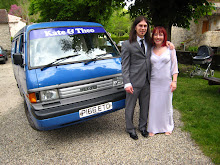
Theo and Kate get married and then leave in their campervan Sheena. They arrive in France but it's too cold to go the beach so go to Kate's mother's instead, where they eat well and have fun.
Next they go to Spain where they drink beer and have fun. They see lots of storks but don't go to the beach. Then they go to Portugal and drink Port, ride trams and hear fado, but it's still too cold to go to the beach.
So they go back to Spain and see some Flamenco and more lovely buildings. Theo breaks Sheena's rear windscreen and then Sheena sulks and wont start; a sulky electrician fixes her. Kate and Theo go to an ace festival, meet some ace people, then an ace campsite and meet some more ace people. They finally go to the beach. They go on a big drive to another festival, which isn't quite as good but they do meet some friends so it's all ok.
They go back to France and meet more friends. They try to get Sheena's rear windscreen fixed but they can't so they go to the beach instead.
Theo and Kate get married and then leave in their campervan Sheena. They arrive in France but it's too cold to go the beach so go to Kate's mother's instead, where they eat well and have fun.
Next they go to Spain where they drink beer and have fun. They see lots of storks but don't go to the beach. Then they go to Portugal and drink Port, ride trams and hear fado, but it's still too cold to go to the beach.
So they go back to Spain and see some Flamenco and more lovely buildings. Theo breaks Sheena's rear windscreen and then Sheena sulks and wont start; a sulky electrician fixes her. Kate and Theo go to an ace festival, meet some ace people, then an ace campsite and meet some more ace people. They finally go to the beach. They go on a big drive to another festival, which isn't quite as good but they do meet some friends so it's all ok.
They go back to France and meet more friends. They try to get Sheena's rear windscreen fixed but they can't so they go to the beach instead.
Saturday, 10 May 2008
Lisbon: planning to plan
Kate and I suck at planning things.
Ok, so our wedding went pretty well - we're not saying that things go badly when we plan them, it's just that we seem to be rubbish at sticking to plans. We're too impetuous, too easily distracted and too prone to improvise. For example, originally our European travel plans hadn't included Spain and Portugal AT ALL - now we're spending a month here (all largely because of a thread we saw on the CHOKE forum). As a result we had hardly any plans, and hadn't even got around to purchasing a proper road atlas for the Iberian peninsular until we got to Bilbao.
Today was another great example of us making plans, not sticking to them, making more plans, not sticking to those either, but of generally having a lovely, if footsore, day anyway.

We're in Lisbon, the capital of Portugal, a south-facing port on the Tajo river. Our plan had been to get up early, have breakfast, head into town before 9, wander around and see some of the sights, then come back for a late lunch and siesta before heading back into Lisbon for a night out in the big city. We started well, but by 12.30 we didn't really feel we'd seen much by way of the sights, just some lovely narrow, cobbled streets with tall town houses on the sides and cafe tables in the middle, opening out to big pracas named after various kings and explorers. We did find an ornate street elevator, originally steam powered and a cute funicular tramway, but we decided it was too early to eat out and anyway we weren't that bothered about a night on the tiles. So we bought a day rider (might have been a good plan to get one earlier, but never mind) and headed to the riverside Belem district, where several of Lisbon's best monuments and palaces were to be found.


After changing our plans regarding lunch a couple of times, we found a charming little pavement cafe where we managed to assemble a reasonably decent vegetarian meal from various entree and soup options. Monuments checked out, street art spotted, ice cream eaten, feet beginning to ache, we resolved to do the rest of our sightseeing by tram and bus to make the best use of our four-euro tickets. Inevitably we ended up on a different tram to the one we planned to take, but Kate's instinct was right as we were rewarded by gorgeous views on the castle circular in a splendid old fashioned vehicle with sash windows and leather sunscreens, polished wood and ample chances to exchange greetings with pedestrians and people in passing trams.
Naturally our plans to return to the campsite via a variety of Metro trains and buses were altered, changed and rearranged several times and two missed stops later, we made it back. I had planned to get our washing in from earlier then cook, but Kate had other plans, hence she's cooking and I am blogging. About plans.
Ok, so our wedding went pretty well - we're not saying that things go badly when we plan them, it's just that we seem to be rubbish at sticking to plans. We're too impetuous, too easily distracted and too prone to improvise. For example, originally our European travel plans hadn't included Spain and Portugal AT ALL - now we're spending a month here (all largely because of a thread we saw on the CHOKE forum). As a result we had hardly any plans, and hadn't even got around to purchasing a proper road atlas for the Iberian peninsular until we got to Bilbao.
Today was another great example of us making plans, not sticking to them, making more plans, not sticking to those either, but of generally having a lovely, if footsore, day anyway.

We're in Lisbon, the capital of Portugal, a south-facing port on the Tajo river. Our plan had been to get up early, have breakfast, head into town before 9, wander around and see some of the sights, then come back for a late lunch and siesta before heading back into Lisbon for a night out in the big city. We started well, but by 12.30 we didn't really feel we'd seen much by way of the sights, just some lovely narrow, cobbled streets with tall town houses on the sides and cafe tables in the middle, opening out to big pracas named after various kings and explorers. We did find an ornate street elevator, originally steam powered and a cute funicular tramway, but we decided it was too early to eat out and anyway we weren't that bothered about a night on the tiles. So we bought a day rider (might have been a good plan to get one earlier, but never mind) and headed to the riverside Belem district, where several of Lisbon's best monuments and palaces were to be found.


After changing our plans regarding lunch a couple of times, we found a charming little pavement cafe where we managed to assemble a reasonably decent vegetarian meal from various entree and soup options. Monuments checked out, street art spotted, ice cream eaten, feet beginning to ache, we resolved to do the rest of our sightseeing by tram and bus to make the best use of our four-euro tickets. Inevitably we ended up on a different tram to the one we planned to take, but Kate's instinct was right as we were rewarded by gorgeous views on the castle circular in a splendid old fashioned vehicle with sash windows and leather sunscreens, polished wood and ample chances to exchange greetings with pedestrians and people in passing trams.
Naturally our plans to return to the campsite via a variety of Metro trains and buses were altered, changed and rearranged several times and two missed stops later, we made it back. I had planned to get our washing in from earlier then cook, but Kate had other plans, hence she's cooking and I am blogging. About plans.
Wednesday, 7 May 2008
Town, Gown & Fado
We loved Porto, but mindful of our limited time in Portugal before going to the Rocket Festival (and that there are a lot of places in Spain we still want to visit before the end of May), we decided to push on towards Lisbon. Our guidebook recommended Coimbra as an interesting city to see and as our new South American friends had also given the place their thumbs up, we decided to call in on route.
The city only has one campsite, but it was easy to find, very reasonably priced, has good, clean facilities and a regular bus into town - perfect. It also had the biggest European mix of clientale we'd encountered so far, with fellow campers including Dutch, French, Spanish, Portugese, German and another English couple. AND the young woman on reception spoke some English, so that made everything much more straightforward.
It was very hot in the afternoon - Theo chose to spend it snoozing in Sheena while I mooched around doing domestic things like the washing up and wrestling unsuccessfully with the campsite clothes washing machine. Eventually, I gave up, went and got my three Euros back from reception, only to return and witness one of the Dutch women sticking a load on in nary a blink of the eyes. I've noticed Dutch people seem to be very efficient campers (well, motorhome enthusiasts) - next time I want to do some laundry I think I will lassoo a Netherlander first. It could save me a lot of frustration.
We took the bus into Coimbra for the evening after the inevitable confusion buying tickets - not only does every country have its own system, but as we've discovered in Portugal, every city and individual bus firm does the business of ticket buying and stamping (or not) and return issuing (or not) in a different manner as well. Rather baffling to the unwary foreign traveller, but don't let that put you off. Without taking the bus, how would you get to see the scruffiest suburbs and lowliest housing estates of all these proud cities? It's also cheap and you can get all the thrills of a fairground ride with some of the more gung-ho drivers.
Coimbra is a city with a university at its heart. King Dinis gifted his Coimbra palace to the institution and it's been established in the city since the early thirteenth century. The buildings are crumbling but still impressive, with the university precincts dotted with statues and steeped in a long, proud history.
The town itself has a multitude of steep, narrow streets, lined with tall appartments, many of them tiled in patterns of blue and green and festooned with their residents' drying clothes. We spent a happy hour or so wandering round (after the obligatory cafe pingo and cup of hot chocolate taken outside a cafe beside the Santa Cruz monastery, itself a rather beautiful converted chapel) before going to the Restaurante Jardim da Manga for some food. We were greeted by a very friendly, English-speaking waiter, Diago, who guided us through the vegetarian options at the cafeteria-style sevice counter. We ate our huge platefuls outside beside the water garden, formally laid out with heavily-laden citrus trees dropping their fruit into the quartet of fountains. We got complimentary glasses of port (yay!) and the whole thing cost less than fourteen Euros.
While at the top of the town during our walk, we'd noticed what looked like a festival laid out in the city's riverside park. It turned out Coimbra was midway through it annual student extravaganza, Queima das Fitas. Essentially, ten days of each faculty celebrating that year's graduation with an eclectic mix of live music, beginning after midnight and ending with traditional Portugese Fado.
Having encountered Fado already through seeing Mariza at WOMAD (the stylish young Fado singer, who has almost single-handedly opened it up to the rest of the world) and then Dona Rosa (who I preferred), I was interested to catch some live. Coimbra's most succesful bar is aCapella, where they put on shows every night in a fourteenth century monument. For ten Euros a head you got three shows, explanation and background to the music in Portugese and English and a drink. We got a jug of sangria, which lasted us the night and watched two young guys, one on Portugese guitar, the other on English classical guitar, deliver a beautiful and intricate set of ballads, serenades and dances. They had a singer with them, who was less impressive - not bad on the more uptempo numbers, but tended to confuse emotion for volume on the slower more melancholy songs and had all the over-bearing vibrato of the lead tenor in a small town, church choir.
Nonetheless, it was an enjoyable couple of hours and I was interested to learn that every year each faculty at Coimbra university composes a new fado song so the students can say their farewells. Some of these have become incredibly well-known throughout Portugal and the finale was the 1958 Medical Faculty fado, which had the Portugese members of the audience all singing along...a lovely moment.
When we got outside, this year's graduates had filled Coimbra's streets, many of them still wearing their black graduation gowns with badges sewn on, scout-style. We contemplated joining the celebrations and going along to the party in the park, but all that sangria and dolorous Fado had made us feel sleepy, so we got a taxi back to the campsite. Tomorrow if it's hot, we decided, we would get our laundry done and go canoeing while it was drying and maybe head to the beach later on.
We woke this morning to the familiar sound of raindrops pattering onto Sheena's roof. Nah, we'll get on the road to Lisbon and the laundy will have to wait.
The city only has one campsite, but it was easy to find, very reasonably priced, has good, clean facilities and a regular bus into town - perfect. It also had the biggest European mix of clientale we'd encountered so far, with fellow campers including Dutch, French, Spanish, Portugese, German and another English couple. AND the young woman on reception spoke some English, so that made everything much more straightforward.
It was very hot in the afternoon - Theo chose to spend it snoozing in Sheena while I mooched around doing domestic things like the washing up and wrestling unsuccessfully with the campsite clothes washing machine. Eventually, I gave up, went and got my three Euros back from reception, only to return and witness one of the Dutch women sticking a load on in nary a blink of the eyes. I've noticed Dutch people seem to be very efficient campers (well, motorhome enthusiasts) - next time I want to do some laundry I think I will lassoo a Netherlander first. It could save me a lot of frustration.
We took the bus into Coimbra for the evening after the inevitable confusion buying tickets - not only does every country have its own system, but as we've discovered in Portugal, every city and individual bus firm does the business of ticket buying and stamping (or not) and return issuing (or not) in a different manner as well. Rather baffling to the unwary foreign traveller, but don't let that put you off. Without taking the bus, how would you get to see the scruffiest suburbs and lowliest housing estates of all these proud cities? It's also cheap and you can get all the thrills of a fairground ride with some of the more gung-ho drivers.
Coimbra is a city with a university at its heart. King Dinis gifted his Coimbra palace to the institution and it's been established in the city since the early thirteenth century. The buildings are crumbling but still impressive, with the university precincts dotted with statues and steeped in a long, proud history.
The town itself has a multitude of steep, narrow streets, lined with tall appartments, many of them tiled in patterns of blue and green and festooned with their residents' drying clothes. We spent a happy hour or so wandering round (after the obligatory cafe pingo and cup of hot chocolate taken outside a cafe beside the Santa Cruz monastery, itself a rather beautiful converted chapel) before going to the Restaurante Jardim da Manga for some food. We were greeted by a very friendly, English-speaking waiter, Diago, who guided us through the vegetarian options at the cafeteria-style sevice counter. We ate our huge platefuls outside beside the water garden, formally laid out with heavily-laden citrus trees dropping their fruit into the quartet of fountains. We got complimentary glasses of port (yay!) and the whole thing cost less than fourteen Euros.
While at the top of the town during our walk, we'd noticed what looked like a festival laid out in the city's riverside park. It turned out Coimbra was midway through it annual student extravaganza, Queima das Fitas. Essentially, ten days of each faculty celebrating that year's graduation with an eclectic mix of live music, beginning after midnight and ending with traditional Portugese Fado.
Having encountered Fado already through seeing Mariza at WOMAD (the stylish young Fado singer, who has almost single-handedly opened it up to the rest of the world) and then Dona Rosa (who I preferred), I was interested to catch some live. Coimbra's most succesful bar is aCapella, where they put on shows every night in a fourteenth century monument. For ten Euros a head you got three shows, explanation and background to the music in Portugese and English and a drink. We got a jug of sangria, which lasted us the night and watched two young guys, one on Portugese guitar, the other on English classical guitar, deliver a beautiful and intricate set of ballads, serenades and dances. They had a singer with them, who was less impressive - not bad on the more uptempo numbers, but tended to confuse emotion for volume on the slower more melancholy songs and had all the over-bearing vibrato of the lead tenor in a small town, church choir.
Nonetheless, it was an enjoyable couple of hours and I was interested to learn that every year each faculty at Coimbra university composes a new fado song so the students can say their farewells. Some of these have become incredibly well-known throughout Portugal and the finale was the 1958 Medical Faculty fado, which had the Portugese members of the audience all singing along...a lovely moment.
When we got outside, this year's graduates had filled Coimbra's streets, many of them still wearing their black graduation gowns with badges sewn on, scout-style. We contemplated joining the celebrations and going along to the party in the park, but all that sangria and dolorous Fado had made us feel sleepy, so we got a taxi back to the campsite. Tomorrow if it's hot, we decided, we would get our laundry done and go canoeing while it was drying and maybe head to the beach later on.
We woke this morning to the familiar sound of raindrops pattering onto Sheena's roof. Nah, we'll get on the road to Lisbon and the laundy will have to wait.
Tuesday, 6 May 2008
observations of Portugal (and Spain)
The Spanish label their railways, so when you drive over a railway line is says which line it is, much in the same way that rivers in the UK (and elsewhere) are labeled. Whether this for the benefit of lost travelers or train spotters isn't clear.
The Portuguese have lots of rocks. They are everywhere. You wouldn't think they'd need to bother quarrying for stone seeing as it seems to be pretty much the only thing in some of the fields, but there are loads of quarries anyway.
Whoever decides where to put road signs in Portugal seems to take great delight in misleading would be picnic-ers, as there were a plethora of "picnic-table-under-shady-tree" signs on the way to Porto that lead instead to baking hot service station car parks.
After a schlepp of a drive yesterday, powering (ahem) Sheena up the highest mountain range in Portugal, we are now in the lovely city of Porto. Portugal's second city reminds me equally of Newcastle and Zanzibar, in the way that high, beautiful bridges span the Duoro river between castles and cathedrals, while the old town is full of cramped, tiled, slightly decrepit, but nonetheless attractive buildings. there's a heat haze over the city, but with the breeze from the Atlantic it's cool and pleasant. The lower bank - a separate city called Gaia (more parallels with Tyneside) - is full of Port distillers and wholesalers, their signs dominating the bank. We'll probably head there after we've finished rinsing the various wireless networks we've managed to find while Kate samples the best coffee in Europe.
The Portuguese have lots of rocks. They are everywhere. You wouldn't think they'd need to bother quarrying for stone seeing as it seems to be pretty much the only thing in some of the fields, but there are loads of quarries anyway.
Whoever decides where to put road signs in Portugal seems to take great delight in misleading would be picnic-ers, as there were a plethora of "picnic-table-under-shady-tree" signs on the way to Porto that lead instead to baking hot service station car parks.
After a schlepp of a drive yesterday, powering (ahem) Sheena up the highest mountain range in Portugal, we are now in the lovely city of Porto. Portugal's second city reminds me equally of Newcastle and Zanzibar, in the way that high, beautiful bridges span the Duoro river between castles and cathedrals, while the old town is full of cramped, tiled, slightly decrepit, but nonetheless attractive buildings. there's a heat haze over the city, but with the breeze from the Atlantic it's cool and pleasant. The lower bank - a separate city called Gaia (more parallels with Tyneside) - is full of Port distillers and wholesalers, their signs dominating the bank. We'll probably head there after we've finished rinsing the various wireless networks we've managed to find while Kate samples the best coffee in Europe.
observations of Portugal (and Spain)
The Spanish label their railways, so when you drive over a railway line it says which line it is, much in the same way that rivers in the UK (and elsewhere) are labeled. Whether this is for the benefit of lost travelers or train spotters isn't clear. But it´s probably comforting to know that the train passing beneath you is the 10.45 to Madrid. If you're a train spotter, well that knowledge is clearly invaluable.
The Portuguese have lots of rocks. They are everywhere. You wouldn't think they'd need to bother quarrying for stone seeing as it seems to be pretty much the only crop in some of the fields, but there are loads of quarries anyway.
Whoever decides where to put road signs in Portugal seems to take great delight in misleading would be picnickers, as there were a plethora of "picnic-table-under-shady-tree" signs on the way to Porto that lead instead to baking hot service station car parks.
After a schlepp of a drive yesterday, powering (ahem) Sheena up the highest mountain range in Portugal, we are now in the lovely city of Porto. Portugal's second city reminds me equally of Newcastle and Zanzibar, in the way that high, beautiful bridges span the Douro river between castles and cathedrals, while the old town is full of cramped, tiled, slightly decrepid, but nonetheless attractive buildings. There's a heat haze over the city, but with the breeze from the Atlantic it's cool and pleasant. The lower bank - a separate city called Gaia (more parallels with Tyneside) - is full of Port distillers and wholesalers, their signs dominating the bank. We'll probably head there after we've finished rinsing the various wireless networks we've managed to find while Kate samples the best coffee in Europe.
Later note from Kate:


We certainly did sample the the local tipple shortly afterwards. We deliberately chose the Ferreira tour and degustation because of its strong Portugese connections and spent an enjoyable hour in the company of a couple (Argentinian and Brazilian respectively, but currently resident in the UK so with very good English) being taught all about Port wine by the guide, then an even more enjoyable time sampling the different types and vintages, with the conversation becoming more convivial and extravagent with every sip. By the end of it all, we were firm friends with Cecile and Guillermo, so went and enjoyed some "pingos" together (glorious shots of wonderfully smooth-roasted espresso coffee with a drop of milk...Theo had hot chocolate) at a cafe back in Porto itself before parting company with fond regards all round. We then came upon an uproarous student graduation parade, which put the English graduation tradition of hats in the air to shame. Ah, this is indeed a fine city. And that's not just the Port talking.
The Portuguese have lots of rocks. They are everywhere. You wouldn't think they'd need to bother quarrying for stone seeing as it seems to be pretty much the only crop in some of the fields, but there are loads of quarries anyway.
Whoever decides where to put road signs in Portugal seems to take great delight in misleading would be picnickers, as there were a plethora of "picnic-table-under-shady-tree" signs on the way to Porto that lead instead to baking hot service station car parks.
After a schlepp of a drive yesterday, powering (ahem) Sheena up the highest mountain range in Portugal, we are now in the lovely city of Porto. Portugal's second city reminds me equally of Newcastle and Zanzibar, in the way that high, beautiful bridges span the Douro river between castles and cathedrals, while the old town is full of cramped, tiled, slightly decrepid, but nonetheless attractive buildings. There's a heat haze over the city, but with the breeze from the Atlantic it's cool and pleasant. The lower bank - a separate city called Gaia (more parallels with Tyneside) - is full of Port distillers and wholesalers, their signs dominating the bank. We'll probably head there after we've finished rinsing the various wireless networks we've managed to find while Kate samples the best coffee in Europe.
Later note from Kate:


We certainly did sample the the local tipple shortly afterwards. We deliberately chose the Ferreira tour and degustation because of its strong Portugese connections and spent an enjoyable hour in the company of a couple (Argentinian and Brazilian respectively, but currently resident in the UK so with very good English) being taught all about Port wine by the guide, then an even more enjoyable time sampling the different types and vintages, with the conversation becoming more convivial and extravagent with every sip. By the end of it all, we were firm friends with Cecile and Guillermo, so went and enjoyed some "pingos" together (glorious shots of wonderfully smooth-roasted espresso coffee with a drop of milk...Theo had hot chocolate) at a cafe back in Porto itself before parting company with fond regards all round. We then came upon an uproarous student graduation parade, which put the English graduation tradition of hats in the air to shame. Ah, this is indeed a fine city. And that's not just the Port talking.
Subscribe to:
Posts (Atom)

 Posts
Posts

